


Page 295 -
P. 295
CHAPTER 8 • IMPLEMENTING STRATEGIES: MARKETING, FINANCE/ACCOUNTING, R&D, AND MIS ISSUES  261

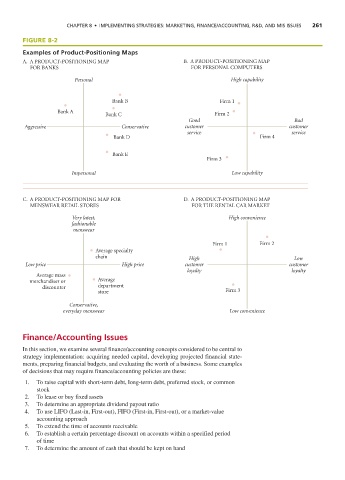
              FIGURE 8-2
              Examples of Product-Positioning Maps
              A.  A PRODUCT-POSITIONING MAP                       B.  A PRODUCT-POSITIONING MAP
                FOR BANKS                                            FOR PERSONAL COMPUTERS

                               Personal                                           High capability


                                           Bank B                             Firm 1
                         Bank A
                                         Bank C                              Firm 2
                                                                    Good                               Bad
              Aggressive                      Conservative         customer                          customer
                                                                    service                           service
                                           Bank D                                          Firm 4


                                           Bank E
                                                                          Firm 3

                              Impersonal                                          Low capability


              C.  A PRODUCT-POSITIONING MAP FOR                   D.  A PRODUCT-POSITIONING MAP
                 MENSWEAR RETAIL STORES                              FOR THE RENTAL CAR MARKET

                              Very latest,                                       High convenience
                              fashionable
                              menswear

                                                                            Firm 1         Firm 2
                                      Average specialty
                                      chain                         High                               Low
               Low price                      High price           customer                          customer
                                                                    loyalty                           loyalty
                  Average mass
                merchandiser or       Average
                    discounter        department
                                      store                                     Firm 3

                             Conservative,
                           everyday menswear                                      Low convenience


              Finance/Accounting Issues

              In this section, we examine several finance/accounting concepts considered to be central to
              strategy implementation: acquiring needed capital, developing projected financial state-
              ments, preparing financial budgets, and evaluating the worth of a business. Some examples
              of decisions that may require finance/accounting policies are these:

              1.  To raise capital with short-term debt, long-term debt, preferred stock, or common
                  stock
              2.  To lease or buy fixed assets
              3.  To determine an appropriate dividend payout ratio
              4.  To use LIFO (Last-in, First-out), FIFO (First-in, First-out), or a market-value
                  accounting approach
              5.  To extend the time of accounts receivable
              6.  To establish a certain percentage discount on accounts within a specified period
                  of time
              7.  To determine the amount of cash that should be kept on hand

