


Page 431 -
P. 431
CASE 3 • JETBLUE AIRWAYS CORPORATION — 2009  27

                  Much of JetBlue’s business model of low faces came right out of Southwest
              Airlines’ playbook. This is no surprise since JetBlue founder, David Neeleman, was fired
              by Southwest in 1999.
                  In 2006, JetBlue published its first corporate sustainability report, the “1st Annual
              Environmental and Social Report 2006,” addressing its environmental efforts concerning
              greenhouse gas emissions, conservation efforts, and social responsibility initiatives. In
              regard to community services, the company also is committed and has aligned itself with
              not-for-profit organizations that focus on children, education, communities, and the envi-
              ronment. The company also encourages its crew members to help make a difference by
              enriching the lives of the individuals and communities they serve.
                  Like Southwest, JetBlue prides itself on providing superior customer service.
              In 2007, JetBlue introduced the JetBlue Airways Customer Bill of Rights, which
              provides compensation to customers who experience avoidable inconveniences (and
              some unavoidable circumstances). The Bill of Rights commits JetBlue to perform at
              high service standards by holding it accountable if it does not. The company is the first
              and currently the only major airline to provide such a fundamental benefit for its
              customers.
                  In 2008, JetBlue introduced refundable fares and new payment options for cus-
              tomers, and it also launched jetblue.com en español, a Spanish version of their Web site,
              http://hola.jetblue.com/enes/. JetBlue was also able to maintain cost per available seat
              mile, excluding fuel, of 5.94 cents, which is among the lowest reported by all other major
              U.S. airlines. By scheduling and operating aircraft efficiently, JetBlue has high aircraft uti-
              lization as it spreads fixed costs over many flights and available seat miles. For the year
              ended December 31, 2008, their aircraft operated an average of 12.1 hours per day, which
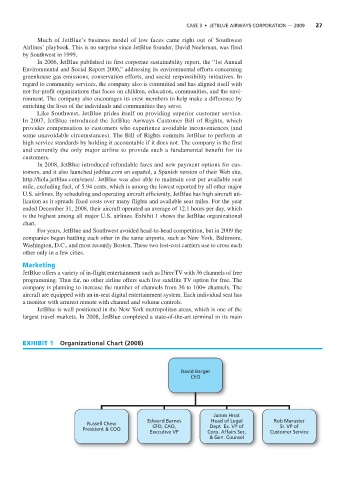
              is the highest among all major U.S. airlines. Exhibit 1 shows the JetBlue organizational
              chart.
                  For years, JetBlue and Southwest avoided head-to-head competition, but in 2009 the
              companies began battling each other in the same airports, such as New York, Baltimore,
              Washington, D.C., and most recently Boston. These two lost-cost carriers use to cross each
              other only in a few cities.

              Marketing
              JetBlue offers a variety of in-flight entertainment such as DirecTV with 36 channels of free
              programming. Thus far, no other airline offers such live satellite TV option for free. The
              company is planning to increase the number of channels from 36 to 100+ channels. The
              aircraft are equipped with an in-seat digital entertainment system. Each individual seat has
              a monitor with armrest remote with channel and volume controls.
                  JetBlue is well positioned in the New York metropolitan areas, which is one of the
              largest travel markets. In 2008, JetBlue completed a state-of-the-art terminal in its main


              EXHIBIT 1   Organizational Chart (2008)


                                                                 David Barger
                                                                     CEO


                                                                            James Hnat
                                                       Edward Barnes       Head of Legal        Rob Maruster
                                   Russell Chew
                                 President & COO        CFO, CAO,          Dept  Ex. VP of        Sr. VP of
                                                       Executive VP       Corp. Affairs Sec.   Customer Service
                                                                           & Gen. Counsel

