


Page 120 - Materials Chemistry, Second Edition
P. 120
Ch003-P373623.qxd  3/22/07  5:29 PM  Page 99
                TABLE 3.1             Sustainable Development and Industrial Ecology  99
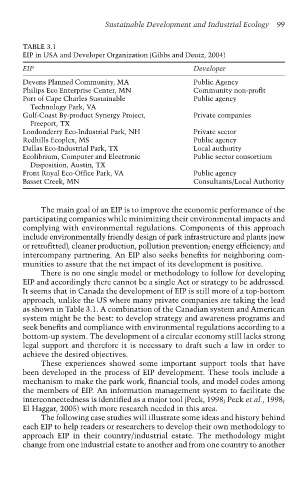
                EIP in USA and Developer Organization (Gibbs and Deutz, 2004)

                EIP                                           Developer
                Devens Planned Community, MA                  Public Agency
                Philips Eco Enterprise Center, MN             Community non-profit
                Port of Cape Charles Sustainable              Public agency
                  Technology Park, VA
                Gulf-Coast By-product Synergy Project,        Private companies
                  Freeport, TX
                Londonderry Eco-Industrial Park, NH           Private sector
                Redhills Ecoplex, MS                          Public agency
                Dallas Eco-Industrial Park, TX                Local authority
                Ecolibrium, Computer and Electronic           Public sector consortium
                  Disposition, Austin, TX
                Front Royal Eco-Office Park, VA                Public agency
                Basset Creek, MN                              Consultants/Local Authority


                     The main goal of an EIP is to improve the economic performance of the
                participating companies while minimizing their environmental impacts and
                complying with environmental regulations. Components of this approach
                include environmentally friendly design of park infrastructure and plants (new
                or retrofitted), cleaner production, pollution prevention; energy efficiency; and
                intercompany partnering. An EIP also seeks benefits for neighboring com-
                munities to assure that the net impact of its development is positive.
                     There is no one single model or methodology to follow for developing
                EIP and accordingly there cannot be a single Act or strategy to be addressed.
                It seems that in Canada the development of EIP is still more of a top-bottom
                approach, unlike the US where many private companies are taking the lead
                as shown in Table 3.1. A combination of the Canadian system and American
                system might be the best: to develop strategy and awareness programs and
                seek benefits and compliance with environmental regulations according to a
                bottom-up system. The development of a circular economy still lacks strong
                legal support and therefore it is necessary to draft such a law in order to
                achieve the desired objectives.
                     These experiences showed some important support tools that have
                been developed in the process of EIP development. These tools include a
                mechanism to make the park work, financial tools, and model codes among
                the members of EIP. An information management system to facilitate the
                interconnectedness is identified as a major tool (Peck, 1998; Peck et al., 1998;
                El Haggar, 2005) with more research needed in this area.
                     The following case studies will illustrate some ideas and history behind
                each EIP to help readers or researchers to develop their own methodology to
                approach EIP in their country/industrial estate. The methodology might
                change from one industrial estate to another and from one country to another

