


Page 122 - Materials Chemistry, Second Edition
P. 122
Ch003-P373623.qxd  3/22/07  5:29 PM  Page 101
                                     Sustainable Development and Industrial Ecology
                                                                                   101
                     • Novo Nordisk, a multinational biotechnological company produc-
                       ing pharmaceuticals including 40% of the world’s supply of insulin
                       and industrial enzymes with annual sales over $2 billion.
                     • The Municipality of Kalundborg supplies district heating to the 20,000
                       residents, as well as water to the homes and industries.

                Other partners joined the symbiosis based on the waste of the core partners
                as a byproduct. They ended up with the following added partners as will be
                explained later in detail:

                     • Bioteknisk Jordrens Soilrem – a soil remediation company that joined
                       the symbiosis in 1998.
                     • Fish farm – consists of 57 fish ponds.
                     • Fertilizer farm.
                     • Cement company – Aalborg Portland and road paving.
                     • Kemira – a sulfuric acid producer.

                The history of structuring Kalundborg
                The history of structuring Kalundborg as an eco-industrial park was based
                mainly on individual and independent agreements according to the follow-
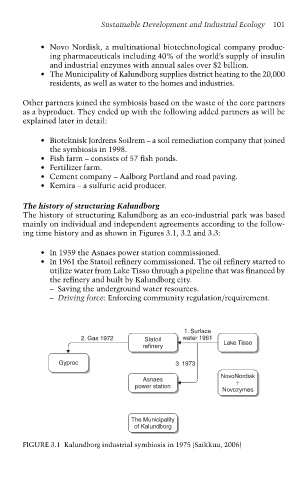
                ing time history and as shown in Figures 3.1, 3.2 and 3.3:

                     • In 1959 the Asnaes power station commissioned.
                     • In 1961 the Statoil refinery commissioned. The oil refinery started to
                       utilize water from Lake Tisso through a pipeline that was financed by
                       the refinery and built by Kalundborg city.
                       – Saving the underground water resources.
                       – Driving force: Enforcing community regulation/requirement.


                                                           1. Surface
                                2. Gas 1972      Statoil   water 1961
                                                refinery              Lake Tisso
                          Gyproc                         3. 1973

                                                                     NovoNordisk
                                                Asnaes
                                              power station
                                                                     Novozymes


                                             The Municipality
                                              of Kalundborg

                FIGURE 3.1 Kalundborg industrial symbiosis in 1975 (Saikkuu, 2006)

