


Page 369 - Sustainable On-Site CHP Systems Design, Construction, and Operations
P. 369
342    Ca s e  S t u d y 2


        Key Results
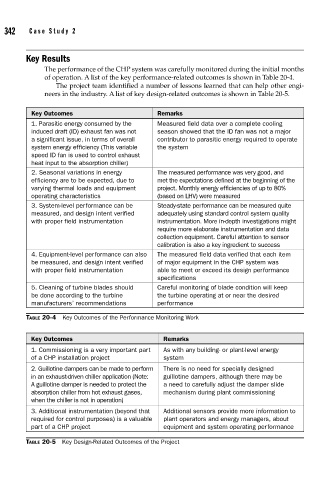
             The performance of the CHP system was carefully monitored during the initial months
             of operation. A list of the key performance-related outcomes is shown in Table 20-4.
                The project team identified a number of lessons learned that can help other engi-
             neers in the industry. A list of key design-related outcomes is shown in Table 20-5.


          Key Outcomes                       Remarks
          1. Parasitic energy consumed by the   Measured field data over a complete cooling
          induced draft (ID) exhaust fan was not   season showed that the ID fan was not a major
          a significant issue, in terms of overall   contributor to parasitic energy required to operate
          system energy efficiency (This variable   the system
          speed ID fan is used to control exhaust
          heat input to the absorption chiller)
          2. Seasonal variations in energy   The measured performance was very good, and
          efficiency are to be expected, due to   met the expectations defined at the beginning of the
          varying thermal loads and equipment   project. Monthly energy efficiencies of up to 80%
          operating characteristics          (based on LHV) were measured
          3. System-level performance can be   Steady-state performance can be measured quite
          measured, and design intent verified   adequately using standard control system quality
          with proper field instrumentation  instrumentation. More in-depth investigations might
                                             require more elaborate instrumentation and data
                                             collection equipment. Careful attention to sensor
                                             calibration is also a key ingredient to success
          4. Equipment-level performance can also   The measured field data verified that each item
          be measured, and design intent verified   of major equipment in the CHP system was
          with proper field instrumentation  able to meet or exceed its design performance
                                             specifications
          5. Cleaning of turbine blades should   Careful monitoring of blade condition will keep
          be done according to the turbine   the turbine operating at or near the desired
          manufacturers’ recommendations     performance
        TABLE 20-4  Key Outcomes of the Performance Monitoring Work


          Key Outcomes                        Remarks
          1. Commissioning is a very important part   As with any building- or plant-level energy
          of a CHP installation project       system
          2. Guillotine dampers can be made to perform   There is no need for specially designed
          in an exhaust-driven chiller application (Note:   guillotine dampers, although there may be
          A guillotine damper is needed to protect the   a need to carefully adjust the damper slide
          absorption chiller from hot exhaust gases,   mechanism during plant commissioning
          when the chiller is not in operation)
          3. Additional instrumentation (beyond that   Additional sensors provide more information to
          required for control purposes) is a valuable   plant operators and energy managers, about
          part of a CHP project               equipment and system operating performance

        TABLE 20-5  Key Design-Related Outcomes of the Project

