


Page 370 - Sustainable On-Site CHP Systems Design, Construction, and Operations
P. 370
Fort Bragg CHP     343


               Key Outcomes                       Remarks
               1. Site operating staff should maintain   Poor planning can result in lost operating
               a proper inventory of critical spare   time of the CHP system from unplanned
               parts or plan carefully to be sure they   outages caused by a lack of the necessary
               are procured before they are needed.   spare parts
               Examples are air and fuel filters, and
               other key consumables
               2. High fuel prices (vs. electric prices),   This illustrates the benefit of having control
               during periods of low thermal loads can   optimization capability
               make it uneconomical to operate the
               CHP system
               3. If not carefully planned, emissions   Begin the permitting process early,
               permitting can delay initial plant start-up   and follow up to make certain that all
               and commissioning                  requirements are met prior to completion
                                                  of the site construction work
               4. Interconnection with local electric   Coordination with the electric utility on
               utility (protective relaying, etc.) is a key   commissioning the interconnection is one
               element of a CHP project           of the key elements of plant start-up

             TABLE 20-6  Key Operations-Related Outcomes of the Project


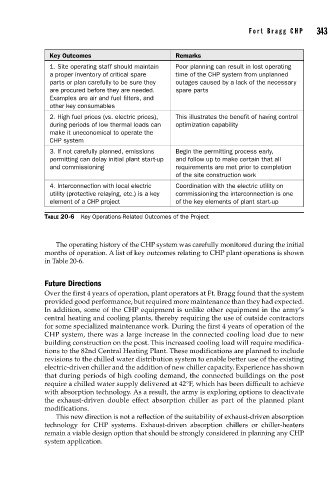
                The operating history of the CHP system was carefully monitored during the initial
             months of operation. A list of key outcomes relating to CHP plant operations is shown
             in Table 20-6.


             Future Directions
             Over the first 4 years of operation, plant operators at Ft. Bragg found that the system
             provided good performance, but required more maintenance than they had expected.
             In addition, some of the CHP equipment is unlike other equipment in the army’s
             central heating and cooling plants, thereby requiring the use of outside contractors
             for some specialized maintenance work. During the first 4 years of operation of the
             CHP system, there was a large increase in the connected cooling load due to new
             building construction on the post. This increased cooling load will require modifica-
             tions to the 82nd Central Heating Plant. These modifications are planned to include
             revisions to the chilled water distribution system to enable better use of the existing
             electric-driven chiller and the addition of new chiller capacity. Experience has shown
             that during periods of high cooling demand, the connected buildings on the post
             require a chilled water supply delivered at 42°F, which has been difficult to achieve
             with absorption technology. As a result, the army is exploring options to deactivate
             the exhaust-driven double effect absorption chiller as part of the planned plant
             modifications.
                This new direction is not a reflection of the suitability of exhaust-driven absorption
             technology for CHP systems. Exhaust-driven absorption chillers or chiller-heaters
             remain a viable design option that should be strongly considered in planning any CHP
             system application.

