


Page 1040 - The Mechatronics Handbook
P. 1040
36.9 Boolean Algebra


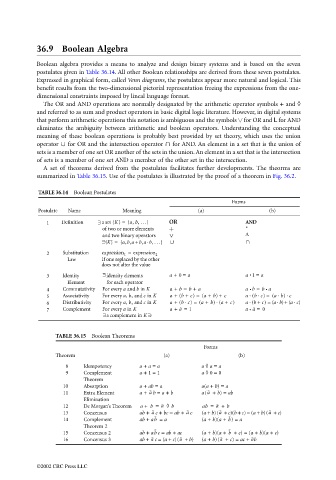
                                 Boolean algebra provides a means to analyze and design binary systems and is based on the seven
                                 postulates given in Table 36.14. All other Boolean relationships are derived from these seven postulates.
                                 Expressed in graphical form, called Venn diagrams, the postulates appear more natural and logical. This
                                 benefit results from the two-dimensional pictorial representation freeing the expressions from the one-
                                 dimensional constraints imposed by lineal language format.
                                   The OR and AND operations are normally designated by the arithmetic operator symbols + and ◊
                                 and referred to as sum and product operators in basic digital logic literature. However, in digital systems
                                 that perform arithmetic operations this notation is ambiguous and the symbols     for OR and L for AND
                                 eliminates the ambiguity between arithmetic and boolean operators. Understanding the conceptual
                                 meaning of these boolean operations is probably best provided by set theory, which uses the union
                                 operator   for OR and the intersection operator   for AND. An element in a set that is the union of
                                 sets is a member of one set OR another of the sets in the union. An element in a set that is the intersection
                                 of sets is a member of one set AND a member of the other set in the intersection.
                                   A set of theorems derived from the postulates facilitates further developments. The theorms are
                                 summarized in Table 36.15. Use of the postulates is illustrated by the proof of a theorem in Fig. 36.2.


                                  TABLE 36.14  Boolean Postulates
                                                                                            Forms
                                  Postulate  Name          Meaning                (a)                  (b)
                                    1    Definition  ∃  a set {K } = {a, b,. . .}  OR            AND
                                                     of two or more elements  +
                                                     and two binary operators                    V
                                                       {K} = {a,b,a + b,a· b,. . .}
                                    2    Substitution  expression = expression 2
                                                            1
                                           Law       If one replaced by the other
                                                     does not alter the value
                                    3    Identity    ∃ identity elements  a + 0 = a             a 1 = a
                                           Element    for each operator
                                    4    Commutativity  For every a and b in K  a + b = b + a   a b = ba
                                    5    Associativity  For every a, b, and c in K  a + (b + c) = (a + b) + c  a · (b · c) = (a · b) · c
                                    6    Distributivity  For every a, b, and c in K  a + (b · c) = (a + b) · (a + c)  a · (b + c) = (a · b) + (a · c)
                                                                                                  -
                                                                            -
                                    7    Complement  For every a in K    a + a = 1              aa = 0
                                                     ∃ a complement in K
                                       TABLE 36.15  Boolean Theorems

                                                                                    Forms
                                       Theorem                         (a)                    (b)
                                          8    Idempotency      a + a = a          a ◊ a = a
                                          9     Complement      a + 1 = 1          a ◊ 0 = 0
                                                Theorem
                                         10    Absorption       a + ab = a         a(a + b) = a
                                                                   a
                                         11    Extra Element    a +  b = a + b     a(a   + b) = ab
                                                Elimination
                                                                       a
                                                                                       a
                                         12     De Morgan’s Theorem  a +   b   =  ◊ b  ab  =  +  b
                                                                              a
                                                                    a
                                         13     Concensus       ab +  c + bc = ab +  c  (a + b)(a  + c)(b + c) = (a + b)(a  + c)
                                         14     Complement      ab + a  = a        (a + b)(a + b)  = a
                                                                     b
                                                Theorem 2
                                                                                           b
                                         15     Concensus 2     ab + ac = ab + ac  (a + b)(a +   + c) = (a + b)(a + c)
                                                                     b
                                                                                                  a
                                                                    a
                                         16     Concensus 3     ab +  c = (a + c)(a  + b)  (a + b)(a  + c) = ac +  b
                                 ©2002 CRC Press LLC

