


Page 1128 - The Mechatronics Handbook
P. 1128
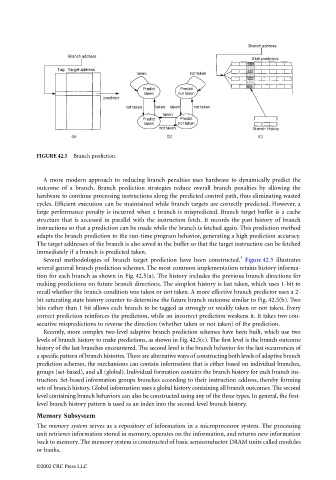
FIGURE 42.5  Branch prediction.


                                   A more modern approach to reducing branch penalties uses hardware to dynamically predict the
                                 outcome of a branch. Branch prediction strategies reduce overall branch penalties by allowing the
                                 hardware to continue processing instructions along the predicted control path, thus eliminating wasted
                                 cycles. Efficient execution can be maintained while branch targets are correctly predicted. However, a
                                 large performance penalty is incurred when a branch is mispredicted. Branch target buffer is a cache
                                 structure that is accessed in parallel with the instruction fetch. It records the past history of branch
                                 instructions so that a prediction can be made while the branch is fetched again. This prediction method
                                 adapts the branch prediction to the run-time program behavior, generating a high prediction accuracy.
                                 The target addresses of the branch is also saved in the buffer so that the target instruction can be fetched
                                 immediately if a branch is predicted taken.
                                                                                               3
                                   Several methodologies of branch target prediction have been constructed.   Figure 42.5  illustrates
                                 several general branch prediction schemes. The most common implementation retains history informa-
                                 tion for each branch as shown in Fig. 42.5(a). The history includes the previous branch directions for
                                 making predictions on future branch directions. The simplest history is last taken, which uses 1-bit to
                                 recall whether the branch condition was taken or not taken. A more effective branch predictor uses a 2-
                                 bit saturating state history counter to determine the future branch outcome similar to Fig. 42.5(b). Two
                                 bits rather than 1 bit allows each branch to be tagged as strongly or weakly taken or not taken. Every
                                 correct prediction reinforces the prediction, while an incorrect prediction weakens it. It takes two con-
                                 secutive mispredictions to reverse the direction (whether taken or not taken) of the prediction.
                                   Recently, more complex two-level adaptive branch prediction schemes have been built, which use two
                                 levels of branch history to make predictions, as shown in Fig. 42.5(c). The first level is the branch outcome
                                 history of the last branches encountered. The second level is the branch behavior for the last occurrences of
                                 a specific pattern of branch histories. There are alternative ways of constructing both levels of adaptive branch
                                 prediction schemes, the mechanisms can contain information that is either based on individual branches,
                                 groups (set-based), and all (global). Individual formation contains the branch history for each branch ins-
                                 truction. Set-based information groups branches according to their instruction address, thereby forming
                                 sets of branch history. Global information uses a global history containing all branch outcomes. The second
                                 level containing branch behaviors can also be constructed using any of the three types. In general, the first-
                                 level branch history pattern is used as an index into the second-level branch history.

                                 Memory Subsystem
                                 The memory system serves as a repository of information in a microprocessor system. The processing
                                 unit retrieves information stored in memory, operates on the information, and returns new information
                                 back to memory. The memory system is constructed of basic semiconductor DRAM units called modules
                                 or banks.

                                 ©2002 CRC Press LLC

