


Page 1133 - The Mechatronics Handbook
P. 1133
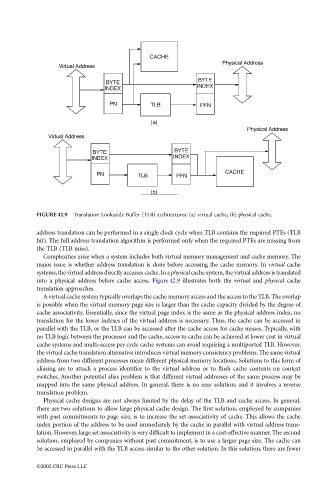
FIGURE 42.9  Translation Lookaside Buffer (TLB) architectures: (a) virtual cache, (b) physical cache.

                                 address translation can be performed in a single clock cycle when TLB contains the required PTEs (TLB
                                 hit). The full address translation algorithm is performed only when the required PTEs are missing from
                                 the TLB (TLB miss).
                                   Complexities arise when a system includes both virtual memory management and cache memory. The
                                 major issue is whether address translation is done before accessing the cache memory. In virtual cache
                                 systems, the virtual address directly accesses cache. In a physical cache system, the virtual address is translated
                                 into a physical address before cache access.  Figure 42.9 illustrates both the  virtual and  physical cache
                                 translation approaches.
                                   A virtual cache system typically overlaps the cache memory access and the access to the TLB. The overlap
                                 is possible when the virtual memory page size is larger than the cache capacity divided by the degree of
                                 cache associativity. Essentially, since the virtual page index is the same as the physical address index, no
                                 translation for the lower indexes of the virtual address is necessary. Thus, the cache can be accessed in
                                 parallel with the TLB, or the TLB can be accessed after the cache access for cache misses. Typically, with
                                 no TLB logic between the processor and the cache, access to cache can be achieved at lower cost in virtual
                                 cache systems and multi-access per cycle cache systems can avoid requiring a multiported TLB. However,
                                 the virtual cache translation alternative introduces virtual memory consistency problems. The same virtual
                                 address from two different processes mean different physical memory locations. Solutions to this form of
                                 aliasing are to attach a process identifier to the virtual address or to flush cache contents on context
                                 switches. Another potential alias problem is that different virtual addresses of the same process may be
                                 mapped into the same physical address. In general, there is no easy solution; and it involves a reverse
                                 translation problem.
                                   Physical cache designs are not always limited by the delay of the TLB and cache access. In general,
                                 there are two solutions to allow large physical cache design. The first solution, employed by companies
                                 with past commitments to page size, is to increase the set associativity of cache. This allows the cache
                                 index portion of the address to be used immediately by the cache in parallel with virtual address trans-
                                 lation. However, large set associativity is very difficult to implement in a cost-effective manner. The second
                                 solution, employed by companies without past commitment, is to use a larger page size. The cache can
                                 be accessed in parallel with the TLB access similar to the other solution. In this solution, there are fewer

                                 ©2002 CRC Press LLC

