


Page 95 - The Mechatronics Handbook
P. 95
0066_Frame_C07  Page 5  Wednesday, January 9, 2002  3:39 PM


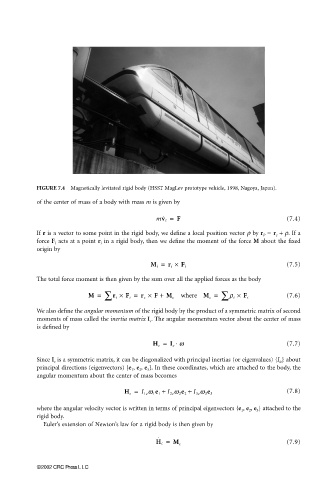
                       FIGURE 7.4  Magnetically levitated rigid body (HSST MagLev prototype vehicle, 1998, Nagoya, Japan).

                       of the center of mass of a body with mass m is given by
                                                          mv ˙ c =  F                             (7.4)


                       If r is a vector to some point in the rigid body, we define a local position vector ρ by r P  = r c  + ρ. If a
                       force F i  acts at a point r i  in a rigid body, then we define the moment of the force M about the fixed
                       origin by
                                                         M i =  r i ×  F i                        (7.5)

                       The total force moment is then given by the sum over all the applied forces as the body

                                                                            =
                                      M =  ∑ r i ×  F i =  r c ×  F +  M c  where  M c ∑ r i ×  F i  (7.6)
                       We also define the angular momentum of the rigid body by the product of a symmetric matrix of second
                       moments of mass called the inertia matrix I c . The angular momentum vector about the center of mass
                       is defined by

                                                         H c =  I c w                             (7.7)
                                                                ⋅
                       Since I c  is a symmetric matrix, it can be diagonalized with principal inertias (or eigenvalues) {I ic } about
                       principal directions (eigenvectors) {e 1 , e 2 , e 3 }. In these coordinates, which are attached to the body, the
                       angular momentum about the center of mass becomes

                                                 H c =  I 1c w 1 e 1 + I 2c w 2 e 2 +  I 3c w 3 e 3  (7.8)

                       where the angular velocity vector is written in terms of principal eigenvectors {e 1 , e 2 , e 3 } attached to the
                       rigid body.
                         Euler’s extension of Newton’s law for a rigid body is then given by

                                                           ˙
                                                          H c =  M c                              (7.9)


                       ©2002 CRC Press LLC

