


Page 325 - Thermal Hydraulics Aspects of Liquid Metal Cooled Nuclear Reactors
P. 325
Simulation of flow-induced vibrations in tube bundles using URANS  295


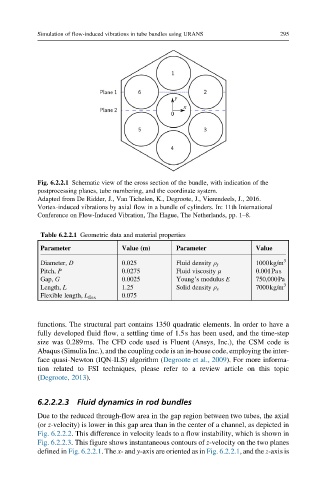
           Fig. 6.2.2.1 Schematic view of the cross section of the bundle, with indication of the
           postprocessing planes, tube numbering, and the coordinate system.
           Adapted from De Ridder, J., Van Tichelen, K., Degroote, J., Vierendeels, J., 2016.
           Vortex-induced vibrations by axial flow in a bundle of cylinders. In: 11th International
           Conference on Flow-Induced Vibration, The Hague, The Netherlands, pp. 1–8.

            Table 6.2.2.1 Geometric data and material properties

            Parameter             Value (m)      Parameter            Value
            Diameter, D           0.025          Fluid density ρ f    1000kg/m 3
            Pitch, P              0.0275         Fluid viscosity μ    0.001Pas
            Gap, G                0.0025         Young’s modulus E    750,000Pa
            Length, L             1.25           Solid density ρ s    7000kg/m 3
            Flexible length, L flex  0.075


           functions. The structural part contains 1350 quadratic elements. In order to have a
           fully developed fluid flow, a settling time of 1.5s has been used, and the time-step
           size was 0.289ms. The CFD code used is Fluent (Ansys, Inc.), the CSM code is
           Abaqus (Simulia Inc.), and the coupling code is an in-house code, employing the inter-
           face quasi-Newton (IQN-ILS) algorithm (Degroote et al., 2009). For more informa-
           tion related to FSI techniques, please refer to a review article on this topic
           (Degroote, 2013).


           6.2.2.2.3 Fluid dynamics in rod bundles

           Due to the reduced through-flow area in the gap region between two tubes, the axial
           (or z-velocity) is lower in this gap area than in the center of a channel, as depicted in
           Fig. 6.2.2.2. This difference in velocity leads to a flow instability, which is shown in
           Fig. 6.2.2.3. This figure shows instantaneous contours of z-velocity on the two planes
           defined in Fig. 6.2.2.1. The x- and y-axis are oriented as in Fig. 6.2.2.1, and the z-axis is

