


Page 328 - Thermal Hydraulics Aspects of Liquid Metal Cooled Nuclear Reactors
P. 328
298                   Thermal Hydraulics Aspects of Liquid Metal Cooled Nuclear Reactors


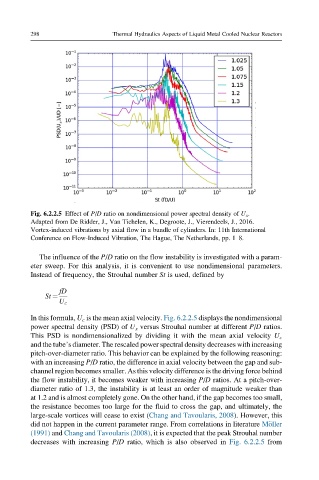
         Fig. 6.2.2.5 Effect of P/D ratio on nondimensional power spectral density of U x .
         Adapted from De Ridder, J., Van Tichelen, K., Degroote, J., Vierendeels, J., 2016.
         Vortex-induced vibrations by axial flow in a bundle of cylinders. In: 11th International
         Conference on Flow-Induced Vibration, The Hague, The Netherlands, pp. 1–8.

            The influence of the P/D ratio on the flow instability is investigated with a param-
         eter sweep. For this analysis, it is convenient to use nondimensional parameters.
         Instead of frequency, the Strouhal number St is used, defined by

                 fD
             St ¼
                 U c
         In this formula, U c is the mean axial velocity. Fig. 6.2.2.5 displays the nondimensional
         power spectral density (PSD) of U x versus Strouhal number at different P/D ratios.
         This PSD is nondimensionalized by dividing it with the mean axial velocity U c
         and the tube’s diameter. The rescaled power spectral density decreases with increasing
         pitch-over-diameter ratio. This behavior can be explained by the following reasoning:
         with an increasing P/D ratio, the difference in axial velocity between the gap and sub-
         channel region becomes smaller. As this velocity difference is the driving force behind
         the flow instability, it becomes weaker with increasing P/D ratios. At a pitch-over-
         diameter ratio of 1.3, the instability is at least an order of magnitude weaker than
         at 1.2 and is almost completely gone. On the other hand, if the gap becomes too small,
         the resistance becomes too large for the fluid to cross the gap, and ultimately, the
         large-scale vortices will cease to exist (Chang and Tavoularis, 2008). However, this
         did not happen in the current parameter range. From correlations in literature M€ oller
         (1991) and Chang and Tavoularis (2008), it is expected that the peak Strouhal number
         decreases with increasing P/D ratio, which is also observed in Fig. 6.2.2.5 from

