


Page 332 - Thermal Hydraulics Aspects of Liquid Metal Cooled Nuclear Reactors
P. 332
Simulation of flow-induced vibrations in tube bundles using URANS  301

           at the same axial coordinate, both streets are typically π radians out of phase. Conse-
           quently, the vibration of tube 1 in the x-direction is stronger than in the y-direction.


           6.2.2.3   Movement-induced vibration


           In this section, a methodology based on coupled CFD and CSM computations to deter-
           mine modal characteristics of a structure in contact with a (turbulent) flow (De Ridder
           et al., 2013) is applied to compute the dynamics in a broad range of flow velocities
           (including the unstable regime) of the clamped-clamped tube in turbulent axial flow
           of Modarres-Sadeghi et al. (2008). The next sections present a description of the
           experiment and a description of the methods used. In the analysis, the subcritical
           dynamics are discussed, followed by an analysis of the buckling regime, and finally,
           the postdivergence regime is treated.


           6.2.2.3.1 Description of the experiment
           The experimental setup in Modarres-Sadeghi et al. (2008) consists of a water loop in
           which a transparent test section with a length of 75cm and a diameter of 20cm is
           mounted vertically. It is assumed that a flat velocity profile exists 2.5cm away from
           the test section walls. Information on turbulence levels is however not available. In
           this test section, a (very) flexible, hollow tube is mounted, consisting of silicone rub-
           ber. The outer tube diameter D o is 0.0156m, the inner tube diameter D i is 0.0094m,
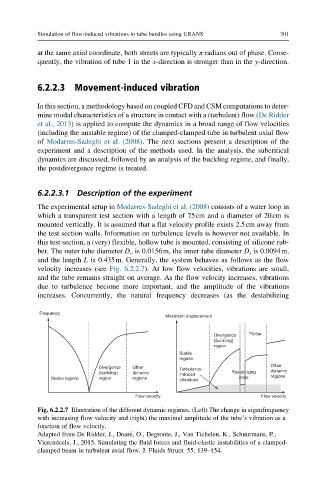
           and the length L is 0.435m. Generally, the system behaves as follows as the flow
           velocity increases (see Fig. 6.2.2.7). At low flow velocities, vibrations are small,
           and the tube remains straight on average. As the flow velocity increases, vibrations
           due to turbulence become more important, and the amplitude of the vibrations
           increases. Concurrently, the natural frequency decreases (as the destabilizing


            Frequency
                                              Maximum displacement
                                                           Divergence  Flutter
                                                           (buckling)
                                                           region
                                                 Stable
                                                 regime
                                                                          Other
                            Divergence  Other    Turbulence-
                            (buckling)  dynamic  induced        Restablizing  dynamic
               Stable regime  region  regions    vibrations       zone    regions

                                      Flow velocity                     Flow velocity
           Fig. 6.2.2.7 Illustration of the different dynamic regimes. (Left) The change in eigenfrequency
           with increasing flow velocity and (right) the maximal amplitude of the tube’s vibration as a
           function of flow velocity.
           Adapted from De Ridder, J., Doar  e, O., Degroote, J., Van Tichelen, K., Schuurmans, P.,
           Vierendeels, J., 2015. Simulating the fluid forces and fluid-elastic instabilities of a clamped-
           clamped beam in turbulent axial flow. J. Fluids Struct. 55, 139–154.

