


Page 334 - Thermal Hydraulics Aspects of Liquid Metal Cooled Nuclear Reactors
P. 334
Simulation of flow-induced vibrations in tube bundles using URANS  303


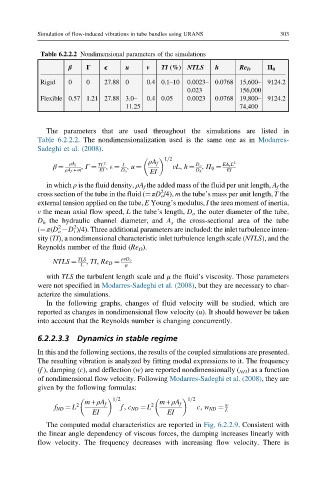
            Table 6.2.2.2 Nondimensional parameters of the simulations
                    β   Γ    e     u     v   TI (%) NTLS   h      Re D   Π 0

            Rigid   0   0    27.88 0     0.4 0.1–10  0.0023– 0.0768 15,600– 9124.2
                                                    0.023         156,000
            Flexible 0.57 1.21 27.88 3.0–  0.4 0.05  0.0023  0.0768 19,800– 9124.2
                                   11.25                          74,400


              The parameters that are used throughout the simulations are listed in
           Table 6.2.2.2. The nondimensionalization used is the same one as in Modarres-
           Sadeghi et al. (2008).
                                              1=2
                    ρA f    TL 2  L      ρA f         D o    EA s L 2
               β ¼     , Γ ¼  , E ¼ , u ¼       vL, h ¼ , Π 0 ¼
                   ρA f + m  EI   D o     EI          D h     EI
              in which ρ is the fluid density, ρA f the added mass of the fluid per unit length, A f the
                                            2
           cross section of the tube in the fluid (¼πD o /4), m the tube’s mass per unit length, T the
           external tension applied on the tube, E Young’s modulus, I the area moment of inertia,
           v the mean axial flow speed, L the tube’s length, D o the outer diameter of the tube,
           D h the hydraulic channel diameter, and A s the cross-sectional area of the tube
                 2
                     2
           (¼π(D o  D i )/4). Three additional parameters are included: the inlet turbulence inten-
           sity (TI), a nondimensional characteristic inlet turbulence length scale (NTLS), and the
           Reynolds number of the fluid (Re D ).
                      TLS         ρvD o
               NTLS ¼   , TI, Re D ¼
                       L           μ
              with TLS the turbulent length scale and μ the fluid’s viscosity. Those parameters
           were not specified in Modarres-Sadeghi et al. (2008), but they are necessary to char-
           acterize the simulations.
              In the following graphs, changes of fluid velocity will be studied, which are
           reported as changes in nondimensional flow velocity (u). It should however be taken
           into account that the Reynolds number is changing concurrently.
           6.2.2.3.3 Dynamics in stable regime

           In this and the following sections, the results of the coupled simulations are presented.
           The resulting vibration is analyzed by fitting modal expressions to it. The frequency
           (f ), damping (c), and deflection (w) are reported nondimensionally ( ND ) as a function
           of nondimensional flow velocity. Following Modarres-Sadeghi et al. (2008), they are
           given by the following formulas:
                                1=2                 1=2

                f ND ¼ L 2  m + ρA f  f , c ND ¼ L 2  m + ρA f  c, w ND ¼  w
                                                              L
                          EI                  EI
              The computed modal characteristics are reported in Fig. 6.2.2.9. Consistent with
           the linear angle dependency of viscous forces, the damping increases linearly with
           flow velocity. The frequency decreases with increasing flow velocity. There is

