


Page 335 - Thermal Hydraulics Aspects of Liquid Metal Cooled Nuclear Reactors
P. 335
304                   Thermal Hydraulics Aspects of Liquid Metal Cooled Nuclear Reactors


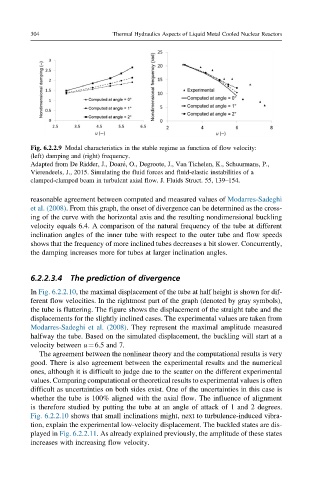
         Fig. 6.2.2.9 Modal characteristics in the stable regime as function of flow velocity:
         (left) damping and (right) frequency.
         Adapted from De Ridder, J., Doar  e, O., Degroote, J., Van Tichelen, K., Schuurmans, P.,
         Vierendeels, J., 2015. Simulating the fluid forces and fluid-elastic instabilities of a
         clamped-clamped beam in turbulent axial flow. J. Fluids Struct. 55, 139–154.

         reasonable agreement between computed and measured values of Modarres-Sadeghi
         et al. (2008). From this graph, the onset of divergence can be determined as the cross-
         ing of the curve with the horizontal axis and the resulting nondimensional buckling
         velocity equals 6.4. A comparison of the natural frequency of the tube at different
         inclination angles of the inner tube with respect to the outer tube and flow speeds
         shows that the frequency of more inclined tubes decreases a bit slower. Concurrently,
         the damping increases more for tubes at larger inclination angles.


         6.2.2.3.4 The prediction of divergence

         In Fig. 6.2.2.10, the maximal displacement of the tube at half height is shown for dif-
         ferent flow velocities. In the rightmost part of the graph (denoted by gray symbols),
         the tube is fluttering. The figure shows the displacement of the straight tube and the
         displacements for the slightly inclined cases. The experimental values are taken from
         Modarres-Sadeghi et al. (2008). They represent the maximal amplitude measured
         halfway the tube. Based on the simulated displacement, the buckling will start at a
         velocity between u¼6.5 and 7.
            The agreement between the nonlinear theory and the computational results is very
         good. There is also agreement between the experimental results and the numerical
         ones, although it is difficult to judge due to the scatter on the different experimental
         values. Comparing computational or theoretical results to experimental values is often
         difficult as uncertainties on both sides exist. One of the uncertainties in this case is
         whether the tube is 100% aligned with the axial flow. The influence of alignment
         is therefore studied by putting the tube at an angle of attack of 1 and 2 degrees.
         Fig. 6.2.2.10 shows that small inclinations might, next to turbulence-induced vibra-
         tion, explain the experimental low-velocity displacement. The buckled states are dis-
         played in Fig. 6.2.2.11. As already explained previously, the amplitude of these states
         increases with increasing flow velocity.

