


Page 337 - Thermal Hydraulics Aspects of Liquid Metal Cooled Nuclear Reactors
P. 337
306                   Thermal Hydraulics Aspects of Liquid Metal Cooled Nuclear Reactors

            0.04                  u = 9    u = 9.5
           Nondimensional displacement at half-length (–)  0.025  u = 8  u = 7.5  u = 7
            0.035
            0.03

            0.02
            0.015
            0.01
            0.005
              0
              0         0.5        1         1.5        2        2.5        3
                                         Time from release (s)
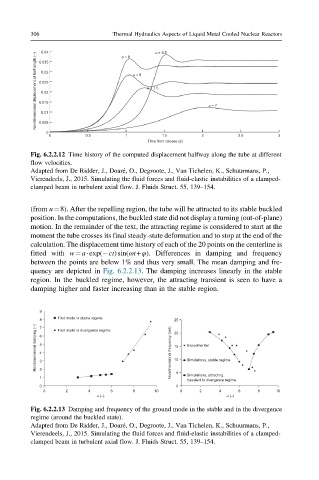
         Fig. 6.2.2.12 Time history of the computed displacement halfway along the tube at different
         flow velocities.
         Adapted from De Ridder, J., Doar  e, O., Degroote, J., Van Tichelen, K., Schuurmans, P.,
         Vierendeels, J., 2015. Simulating the fluid forces and fluid-elastic instabilities of a clamped-
         clamped beam in turbulent axial flow. J. Fluids Struct. 55, 139–154.


         (from u¼8). After the repelling region, the tube will be attracted to its stable buckled
         position. In the computations, the buckled state did not display a turning (out-of-plane)
         motion. In the remainder of the text, the attracting regime is considered to start at the
         moment the tube crosses its final steady-state deformation and to stop at the end of the
         calculation. The displacement time history of each of the 20 points on the centerline is
         fitted with w¼a exp( ct)sin(ωt+φ). Differences in damping and frequency
         between the points are below 1% and thus very small. The mean damping and fre-
         quency are depicted in Fig. 6.2.2.13. The damping increases linearly in the stable
         region. In the buckled regime, however, the attracting transient is seen to have a
         damping higher and faster increasing than in the stable region.


            9
                 First mode in stable regime
            8 7  First mode in divergence regime  25
           Nondimensional damping (–)  6 5 4 3  Nondimensional frequency (rad)  15  Experimental
                                                20


                                                    Simulations, stable regime
                                                10

            1 2                                  5  Simulations, attracting
                                                    transient in divergence regime
            0                                    0
             0     2     4     6     8     10     0    2    4    6     8    10
                           u (–)                              u (–)
         Fig. 6.2.2.13 Damping and frequency of the ground mode in the stable and in the divergence
         regime (around the buckled state).
         Adapted from De Ridder, J., Doar  e, O., Degroote, J., Van Tichelen, K., Schuurmans, P.,
         Vierendeels, J., 2015. Simulating the fluid forces and fluid-elastic instabilities of a clamped-
         clamped beam in turbulent axial flow. J. Fluids Struct. 55, 139–154.

