


Page 339 - Thermal Hydraulics Aspects of Liquid Metal Cooled Nuclear Reactors
P. 339
308                   Thermal Hydraulics Aspects of Liquid Metal Cooled Nuclear Reactors


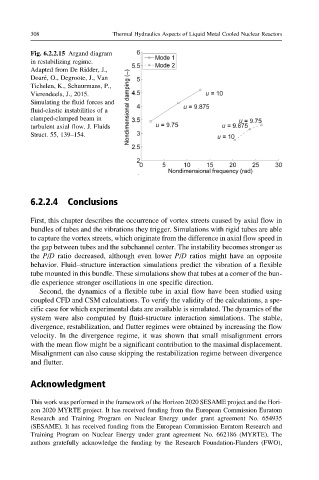
         Fig. 6.2.2.15 Argand diagram
         in restabilizing regime.
         Adapted from De Ridder, J.,
         Doar  e, O., Degroote, J., Van
         Tichelen, K., Schuurmans, P.,
         Vierendeels, J., 2015.
         Simulating the fluid forces and
         fluid-elastic instabilities of a
         clamped-clamped beam in
         turbulent axial flow. J. Fluids
         Struct. 55, 139–154.


         6.2.2.4   Conclusions


         First, this chapter describes the occurrence of vortex streets caused by axial flow in
         bundles of tubes and the vibrations they trigger. Simulations with rigid tubes are able
         to capture the vortex streets, which originate from the difference in axial flow speed in
         the gap between tubes and the subchannel center. The instability becomes stronger as
         the P/D ratio decreased, although even lower P/D ratios might have an opposite
         behavior. Fluid–structure interaction simulations predict the vibration of a flexible
         tube mounted in this bundle. These simulations show that tubes at a corner of the bun-
         dle experience stronger oscillations in one specific direction.
            Second, the dynamics of a flexible tube in axial flow have been studied using
         coupled CFD and CSM calculations. To verify the validity of the calculations, a spe-
         cific case for which experimental data are available is simulated. The dynamics of the
         system were also computed by fluid-structure interaction simulations. The stable,
         divergence, restabilization, and flutter regimes were obtained by increasing the flow
         velocity. In the divergence regime, it was shown that small misalignment errors
         with the mean flow might be a significant contribution to the maximal displacement.
         Misalignment can also cause skipping the restabilization regime between divergence
         and flutter.

         Acknowledgment

         This work was performed in the framework of the Horizon 2020 SESAME project and the Hori-
         zon 2020 MYRTE project. It has received funding from the European Commission Euratom
         Research and Training Program on Nuclear Energy under grant agreement No. 654935
         (SESAME). It has received funding from the European Commission Euratom Research and
         Training Program on Nuclear Energy under grant agreement No. 662186 (MYRTE). The
         authors gratefully acknowledge the funding by the Research Foundation-Flanders (FWO),

