


Page 329 - Thermal Hydraulics Aspects of Liquid Metal Cooled Nuclear Reactors
P. 329
Simulation of flow-induced vibrations in tube bundles using URANS  299

           P  ¼ 1:05 1:2. However, by comparing both experimental and numerical results in
           D
           literature, Chang and Tavoularis (2008) concluded that at very small P/D ratios,
           the opposite trend occurs. This observation is consistent with the difference in peak
           Strouhal number at P/D¼1.025 and P/D¼1.05.


           6.2.2.2.4 Flow-induced vibration by large-scale periodic vortices

           Although Fig. 6.2.2.3 shows that the flow field on opposite sides of a rod is relatively
           coherent, large-scale periodic vortices might still trigger vibrations in beam modes. As
           described in the methodology section, this is tested by performing coupled fluid-
           structure interaction simulations in which a segment of a tube is taken flexible. Both
           ends of the flexible segments are clamped to the rigid parts. The length of this piece is
           chosen to correspond with the wavelength of a typical vortex. The elasticity of the
           material is chosen in such a way that the reduced flow velocity is sufficiently far from
           fluid-elastic instabilities. For a clamped-clamped tube in axial flow, the limit value is
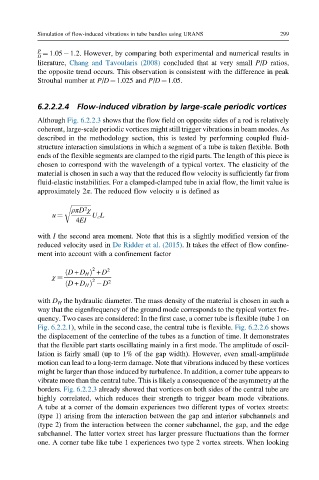
           approximately 2π. The reduced flow velocity u is defined as

                  r ffiffiffiffiffiffiffiffiffiffiffiffiffi
                    ρπD χ
                        2
               u ¼        U c L
                      4EI
           with I the second area moment. Note that this is a slightly modified version of the
           reduced velocity used in De Ridder et al. (2015). It takes the effect of flow confine-
           ment into account with a confinement factor

                          2   2
                   ð D + D H Þ + D
               χ ¼        2
                   ð D + D H Þ  D 2
           with D H the hydraulic diameter. The mass density of the material is chosen in such a
           way that the eigenfrequency of the ground mode corresponds to the typical vortex fre-
           quency. Two cases are considered: In the first case, a corner tube is flexible (tube 1 on
           Fig. 6.2.2.1), while in the second case, the central tube is flexible. Fig. 6.2.2.6 shows
           the displacement of the centerline of the tubes as a function of time. It demonstrates
           that the flexible part starts oscillating mainly in a first mode. The amplitude of oscil-
           lation is fairly small (up to 1% of the gap width). However, even small-amplitude
           motion can lead to a long-term damage. Note that vibrations induced by these vortices
           might be larger than those induced by turbulence. In addition, a corner tube appears to
           vibrate more than the central tube. This is likely a consequence of the asymmetry at the
           borders. Fig. 6.2.2.3 already showed that vortices on both sides of the central tube are
           highly correlated, which reduces their strength to trigger beam mode vibrations.
           A tube at a corner of the domain experiences two different types of vortex streets:
           (type 1) arising from the interaction between the gap and interior subchannels and
           (type 2) from the interaction between the corner subchannel, the gap, and the edge
           subchannel. The latter vortex street has larger pressure fluctuations than the former
           one. A corner tube like tube 1 experiences two type 2 vortex streets. When looking

