


Page 327 - Thermal Hydraulics Aspects of Liquid Metal Cooled Nuclear Reactors
P. 327
Simulation of flow-induced vibrations in tube bundles using URANS  297

           oriented along the mean flow direction, which is from left to right. In order for the flow
           pattern to be visible, only a part of the domain is shown.
              As explained above, a flow instability appears that leads to the wavy character of
           the axial velocity in Fig. 6.2.2.3. Note that the instability occurs in a plane between
           two tubes: for example, plane 2 between tubes 5 and 6. These periodic large-scale vor-
           tices are occurring not only between two adjacent tubes but also in the region between
           a tube and the surrounding wall.
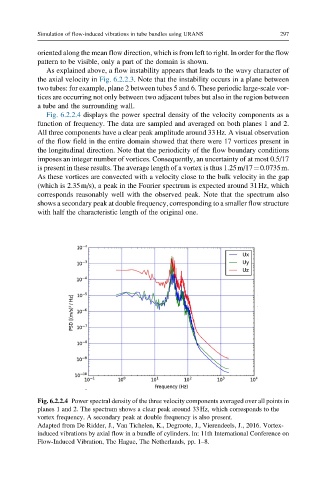
              Fig. 6.2.2.4 displays the power spectral density of the velocity components as a
           function of frequency. The data are sampled and averaged on both planes 1 and 2.
           All three components have a clear peak amplitude around 33Hz. A visual observation
           of the flow field in the entire domain showed that there were 17 vortices present in
           the longitudinal direction. Note that the periodicity of the flow boundary conditions
           imposes an integer number of vortices. Consequently, an uncertainty of at most 0.5/17
           is present in these results. The average length of a vortex is thus 1.25m/17¼0.0735m.
           As these vortices are convected with a velocity close to the bulk velocity in the gap
           (which is 2.35m/s), a peak in the Fourier spectrum is expected around 31Hz, which
           corresponds reasonably well with the observed peak. Note that the spectrum also
           shows a secondary peak at double frequency, corresponding to a smaller flow structure
           with half the characteristic length of the original one.


           Fig. 6.2.2.4 Power spectral density of the three velocity components averaged over all points in
           planes 1 and 2. The spectrum shows a clear peak around 33Hz, which corresponds to the
           vortex frequency. A secondary peak at double frequency is also present.
           Adapted from De Ridder, J., Van Tichelen, K., Degroote, J., Vierendeels, J., 2016. Vortex-
           induced vibrations by axial flow in a bundle of cylinders. In: 11th International Conference on
           Flow-Induced Vibration, The Hague, The Netherlands, pp. 1–8.

