


Page 404 - Thermal Hydraulics Aspects of Liquid Metal Cooled Nuclear Reactors
P. 404
Multi-scale simulations of liquid metal systems                   367


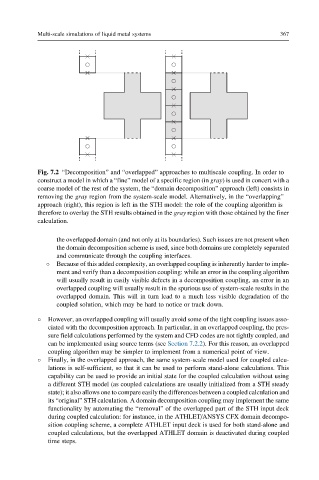
           Fig. 7.2 “Decomposition” and “overlapped” approaches to multiscale coupling. In order to
           construct a model in which a “fine” model of a specific region (in gray) is used in concert with a
           coarse model of the rest of the system, the “domain decomposition” approach (left) consists in
           removing the gray region from the system-scale model. Alternatively, in the “overlapping”
           approach (right), this region is left in the STH model: the role of the coupling algorithm is
           therefore to overlay the STH results obtained in the gray region with those obtained by the finer
           calculation.

                the overlapped domain (and not only at its boundaries). Such issues are not present when
                the domain decomposition scheme is used, since both domains are completely separated
                and communicate through the coupling interfaces.
                 Because of this added complexity, an overlapped coupling is inherently harder to imple-
                ment and verify than a decomposition coupling: while an error in the coupling algorithm
                will usually result in easily visible defects in a decomposition coupling, an error in an
                overlapped coupling will usually result in the spurious use of system-scale results in the
                overlapped domain. This will in turn lead to a much less visible degradation of the
                coupled solution, which may be hard to notice or track down.

              However, an overlapped coupling will usually avoid some of the tight coupling issues asso-
              ciated with the decomposition approach. In particular, in an overlapped coupling, the pres-
              sure field calculations performed by the system and CFD codes are not tightly coupled, and
              can be implemented using source terms (see Section 7.2.2). For this reason, an overlapped
              coupling algorithm may be simpler to implement from a numerical point of view.
              Finally, in the overlapped approach, the same system-scale model used for coupled calcu-
              lations is self-sufficient, so that it can be used to perform stand-alone calculations. This
              capability can be used to provide an initial state for the coupled calculation without using
              a different STH model (as coupled calculations are usually initialized from a STH steady
              state); it also allows one to compare easily the differences between a coupled calculation and
              its “original” STH calculation. A domain decomposition coupling may implement the same
              functionality by automating the “removal” of the overlapped part of the STH input deck
              during coupled calculation: for instance, in the ATHLET/ANSYS CFX domain decompo-
              sition coupling scheme, a complete ATHLET input deck is used for both stand-alone and
              coupled calculations, but the overlapped ATHLET domain is deactivated during coupled
              time steps.

