


Page 409 - Thermal Hydraulics Aspects of Liquid Metal Cooled Nuclear Reactors
P. 409
372                   Thermal Hydraulics Aspects of Liquid Metal Cooled Nuclear Reactors


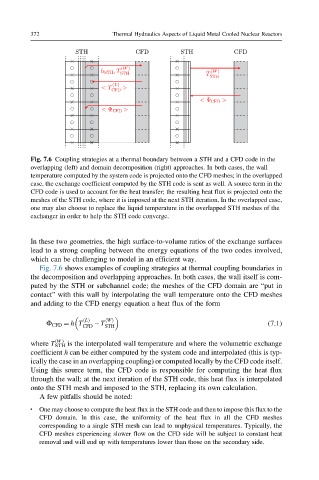
         Fig. 7.6 Coupling strategies at a thermal boundary between a STH and a CFD code in the
         overlapping (left) and domain decomposition (right) approaches. In both cases, the wall
         temperature computed by the system code is projected onto the CFD meshes; in the overlapped
         case, the exchange coefficient computed by the STH code is sent as well. A source term in the
         CFD code is used to account for the heat transfer; the resulting heat flux is projected onto the
         meshes of the STH code, where it is imposed at the next STH iteration. In the overlapped case,
         one may also choose to replace the liquid temperature in the overlapped STH meshes of the
         exchanger in order to help the STH code converge.


         In these two geometries, the high surface-to-volume ratios of the exchange surfaces
         lead to a strong coupling between the energy equations of the two codes involved,
         which can be challenging to model in an efficient way.
            Fig. 7.6 shows examples of coupling strategies at thermal coupling boundaries in
         the decomposition and overlapping approaches. In both cases, the wall itself is com-
         puted by the STH or subchannel code; the meshes of the CFD domain are “put in
         contact” with this wall by interpolating the wall temperature onto the CFD meshes
         and adding to the CFD energy equation a heat flux of the form


                              W
                        L ðÞ  ðÞ
              Φ CFD ¼ hT CFD   T STH                                     (7.1)
                (W)
         where T STH is the interpolated wall temperature and where the volumetric exchange
         coefficient h can be either computed by the system code and interpolated (this is typ-
         ically the case in an overlapping coupling) or computed locally by the CFD code itself.
         Using this source term, the CFD code is responsible for computing the heat flux
         through the wall; at the next iteration of the STH code, this heat flux is interpolated
         onto the STH mesh and imposed to the STH, replacing its own calculation.
            A few pitfalls should be noted:

            One may choose to compute the heat flux in the STH code and then to impose this flux to the
         l
            CFD domain. In this case, the uniformity of the heat flux in all the CFD meshes
            corresponding to a single STH mesh can lead to unphysical temperatures. Typically, the
            CFD meshes experiencing slower flow on the CFD side will be subject to constant heat
            removal and will end up with temperatures lower than those on the secondary side.

