


Page 410 - Thermal Hydraulics Aspects of Liquid Metal Cooled Nuclear Reactors
P. 410
Multi-scale simulations of liquid metal systems                   373

              In the overlapped case, it is not sufficient to project the liquid temperature of the CFD
           l
              domain onto the overlapped domain at the next STH iteration; while this scheme will con-
              verge to a consistent solution, the heat fluxes computed in the STH and CFD codes will not
              be equal, thus violating energy conservation.

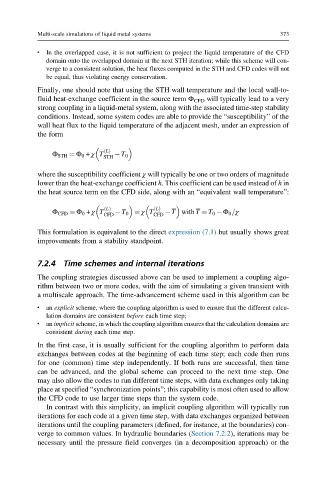
           Finally, one should note that using the STH wall temperature and the local wall-to-
           fluid heat-exchange coefficient in the source term Φ CFD will typically lead to a very
           strong coupling in a liquid-metal system, along with the associated time-step stability
           conditions. Instead, some system codes are able to provide the “susceptibility” of the
           wall heat flux to the liquid temperature of the adjacent mesh, under an expression of
           the form


               Φ STH ¼ Φ 0 + χ T  L ðÞ
                             STH   T 0
           where the susceptibility coefficient χ will typically be one or two orders of magnitude
           lower than the heat-exchange coefficient h. This coefficient can be used instead of h in
           the heat source term on the CFD side, along with an “equivalent wall temperature”:


               Φ CFD ¼ Φ 0 + χ T  L ðÞ   T 0 ¼ χ T  L ðÞ   T with T ¼ T 0  Φ 0 =χ
                             CFD          CFD
           This formulation is equivalent to the direct expression (7.1) but usually shows great
           improvements from a stability standpoint.


           7.2.4 Time schemes and internal iterations
           The coupling strategies discussed above can be used to implement a coupling algo-
           rithm between two or more codes, with the aim of simulating a given transient with
           a multiscale approach. The time-advancement scheme used in this algorithm can be

           l  an explicit scheme, where the coupling algorithm is used to ensure that the different calcu-
              lation domains are consistent before each time step;
           l  an implicit scheme, in which the coupling algorithm ensures that the calculation domains are
              consistent during each time step.
           In the first case, it is usually sufficient for the coupling algorithm to perform data
           exchanges between codes at the beginning of each time step; each code then runs
           for one (common) time step independently. If both runs are successful, then time
           can be advanced, and the global scheme can proceed to the next time step. One
           may also allow the codes to run different time steps, with data exchanges only taking
           place at specified “synchronization points”; this capability is most often used to allow
           the CFD code to use larger time steps than the system code.
              In contrast with this simplicity, an implicit coupling algorithm will typically run
           iterations for each code at a given time step, with data exchanges organized between
           iterations until the coupling parameters (defined, for instance, at the boundaries) con-
           verge to common values. In hydraulic boundaries (Section 7.2.2), iterations may be
           necessary until the pressure field converges (in a decomposition approach) or the

