


Page 407 - Thermal Hydraulics Aspects of Liquid Metal Cooled Nuclear Reactors
P. 407
370                   Thermal Hydraulics Aspects of Liquid Metal Cooled Nuclear Reactors


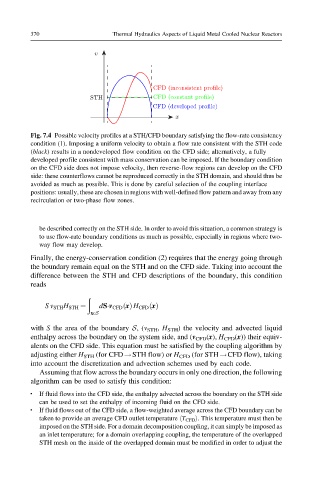
         Fig. 7.4 Possible velocity profiles at a STH/CFD boundary satisfying the flow-rate consistency
         condition (1). Imposing a uniform velocity to obtain a flow rate consistent with the STH code
         (black) results in a nondeveloped flow condition on the CFD side; alternatively, a fully
         developed profile consistent with mass conservation can be imposed. If the boundary condition
         on the CFD side does not impose velocity, then reverse-flow regions can develop on the CFD
         side: these counterflows cannot be reproduced correctly in the STH domain, and should thus be
         avoided as much as possible. This is done by careful selection of the coupling interface
         positions: usually, these are chosen in regions with well-defined flow pattern and away from any
         recirculation or two-phase flow zones.


            be described correctly on the STH side. In order to avoid this situation, a common strategy is
            to use flow-rate boundary conditions as much as possible, especially in regions where two-
            way flow may develop.
         Finally, the energy-conservation condition (2) requires that the energy going through
         the boundary remain equal on the STH and on the CFD side. Taking into account the
         difference between the STH and CFD descriptions of the boundary, this condition
         reads
                         ð
             Sv STH H STH ¼  dS v CFD xðÞ H CFD xðÞ
                          xES
         with S the area of the boundary S,(v STH , H STH ) the velocity and advected liquid
         enthalpy across the boundary on the system side, and (v CFD (x), H CFD (x)) their equiv-
         alents on the CFD side. This equation must be satisfied by the coupling algorithm by
         adjusting either H STH (for CFD!STH flow) or H CFD (for STH!CFD flow), taking
         into account the discretization and advection schemes used by each code.
            Assuming that flow across the boundary occurs in only one direction, the following
         algorithm can be used to satisfy this condition:
            If fluid flows into the CFD side, the enthalpy advected across the boundary on the STH side
         l
            can be used to set the enthalpy of incoming fluid on the CFD side.
            If fluid flows out of the CFD side, a flow-weighted average across the CFD boundary can be
         l
            taken to provide an average CFD outlet temperature hT CFD i. This temperature must then be
            imposed on the STH side. For a domain decomposition coupling, it can simply be imposed as
            an inlet temperature; for a domain overlapping coupling, the temperature of the overlapped
            STH mesh on the inside of the overlapped domain must be modified in order to adjust the

