


Page 382 -
P. 382
Q9-3  How Do Organizations Use Data Warehouses and Data Marts to Acquire Data?

                                                                                   Data             Data                381
                                                 Operational                     Warehouse
                                                 Databases                       Metadata         Warehouse
                                                                                                  Database


                                                                        Data
                                                   Other              Extraction/           Data               Business
                                                  Internal            Cleaning/           Warehouse           Intelligence
                                                   Data               Preparation          DBMS                 Tools
                                                                      Programs


                                                  External
                                                   Data
                    Figure 9-12
                    Components of a Data                                                                   Business Intelligence
                    Warehouse                                                                                   Users


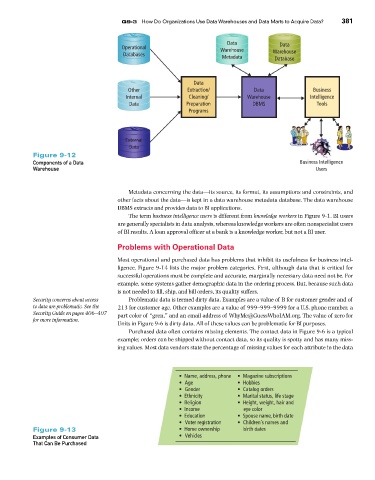
                                                   Metadata concerning the data—its source, its format, its assumptions and constraints, and
                                               other facts about the data—is kept in a data warehouse metadata database. The data warehouse
                                               DBMS extracts and provides data to BI applications.
                                                   The term business intelligence users is different from knowledge workers in Figure 9-1. BI users
                                               are generally specialists in data analysis, whereas knowledge workers are often nonspecialist users
                                               of BI results. A loan approval officer at a bank is a knowledge worker, but not a BI user.
                                               Problems with Operational Data

                                               Most operational and purchased data has problems that inhibit its usefulness for business intel-
                                               ligence. Figure 9-14 lists the major problem categories. First, although data that is critical for
                                               successful operations must be complete and accurate, marginally necessary data need not be. For
                                               example, some systems gather demographic data in the ordering process. But, because such data
                                               is not needed to fill, ship, and bill orders, its quality suffers.
                    Security concerns about access   Problematic data is termed dirty data. Examples are a value of B for customer gender and of
                    to data are problematic. See the   213 for customer age. Other examples are a value of 999–999–9999 for a U.S. phone number, a
                    Security Guide on pages 406–407    part color of “gren,” and an email address of WhyMe@GuessWhoIAM.org. The value of zero for
                    for more information.
                                               Units in Figure 9-6 is dirty data. All of these values can be problematic for BI purposes.
                                                   Purchased data often contains missing elements. The contact data in Figure 9-6 is a typical
                                               example; orders can be shipped without contact data, so its quality is spotty and has many miss-
                                               ing values. Most data vendors state the percentage of missing values for each attribute in the data


                                                                   •  Name, address, phone  •  Magazine subscriptions
                                                                   •  Age             •  Hobbies
                                                                   •  Gender          •  Catalog orders
                                                                   •  Ethnicity       •  Marital status, life stage
                                                                   •  Religion        •  Height, weight, hair and
                                                                   •  Income               eye color
                                                                   •  Education       •  Spouse name, birth date
                                                                   •   Voter registration  •   Children‘s names and
                    Figure 9-13                                    •  Home ownership       birth dates
                    Examples of Consumer Data                      •  Vehicles
                    That Can Be Purchased

