


Page 384 -
P. 384
383
                                                 Q9-3  How Do Organizations Use Data Warehouses and Data Marts to Acquire Data?

                                                   Consider the first problem: too many attributes. Suppose we want to know the factors that
                                               influence how customers respond to a promotion. If we combine internal customer data with
                                               purchased customer data, we will have more than a hundred different attributes to consider. How
                                               do we select among them? In some cases, analysts can ignore the columns they don’t need. But
                                               in more sophisticated data mining analyses, too many attributes can be problematic. Because of
                                               a phenomenon called the curse of dimensionality, the more attributes there are, the easier it is to
                                               build a model that fits the sample data but that is worthless as a predictor. There are other good
                                               reasons for reducing the number of attributes, and one of the major activities in data mining
                                                 concerns efficient and effective ways of selecting attributes.
                                                   The second way to have an excess of data is to have too many data points—too many rows
                                               of data. Suppose we want to analyze clickstream data on CNN.com. How many clicks does that
                                               site receive per month? Millions upon millions! In order to meaningfully analyze such data we
                                               need to reduce the amount of data. One good solution to this problem is statistical sampling.
                                               Organizations should not be reluctant to sample data in such situations.

                                               Data Warehouses Versus Data Marts
                                               To understand the difference between data warehouses and data marts, think of a data  warehouse
                                               as a distributor in a supply chain. The data warehouse takes data from the data manufacturers
                                               (operational systems and other sources), cleans and processes the data, and locates the data on
                                               the shelves, so to speak, of the data warehouse. The data analysts who work with a data  warehouse
                                               are experts at data management, data cleaning, data transformation, data  relationships, and the
                                               like. However, they are not usually experts in a given business function.
                                                   A data mart is a data collection, smaller than the data warehouse, that addresses the needs
                                               of a particular department or functional area of the business. If the data warehouse is the dis-
                                               tributor in a supply chain, then a data mart is like a retail store in a supply chain. Users in the data
                                               mart obtain data that pertain to a particular business function from the data warehouse. Such
                                               users do not have the data management expertise that data warehouse employees have, but they
                                               are knowledgeable analysts for a given business function.
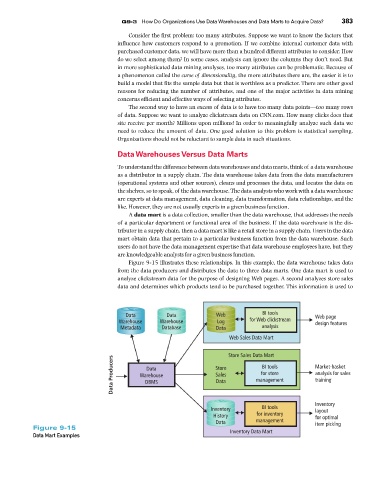
                                                   Figure 9-15 illustrates these relationships. In this example, the data warehouse takes data
                                               from the data producers and distributes the data to three data marts. One data mart is used to
                                               analyze clickstream data for the purpose of designing Web pages. A second analyzes store sales
                                               data and determines which products tend to be purchased together. This information is used to


                                                  Data         Data            Web            BI tools          Web page
                                                Warehouse    Warehouse          Log       for Web clickstream   design features
                                                Metadata      Database         Data           analysis
                                                                                    Web Sales Data Mart


                                                                                   Store Sales Data Mart
                                              Data Producers  Warehouse        Store        management          Market-basket
                                                                                              BI tools
                                                         Data
                                                                                              for store
                                                                                                                analysis for sales
                                                                               Sales
                                                                                                                training
                                                                               Data
                                                        DBMS
                                                                                                                Inventory
                                                                              Inventory       BI tools          layout
                                                                              History        for inventory      for optimal
                                                                               Data         management          item picking
                    Figure 9-15                                                     Inventory Data Mart
                    Data Mart Examples

