


Page 535 - Materials Chemistry, Second Edition
P. 535
CAT3525_C16.qxd  1/27/2005  12:42 PM  Page 506
                       506                       Waste Management Practices: Municipal, Hazardous, and Industrial
                          The LDR program has three major components that address hazardous waste disposal, dilution,
                       and storage. The Disposal Prohibition states that before a hazardous waste can be land-disposed,
                       treatment standards specific to that waste material must be met. A facility may meet such standards
                       by either (U.S. EPA, 1999):
                           ● Treating hazardous chemical constituents in the waste to meet required treatment levels.
                             Any method of treatment can be used to bring concentrations to the appropriate level
                             (except dilution); or
                           ● Treating hazardous waste using a treatment technology specified by the U.S. EPA. Once
                             the waste is treated with the required technology, it can be land disposed.

                          The Dilution Prohibition states that waste must be properly treated and not simply diluted in
                       concentration by adding large volumes of water, soil, or nonhazardous waste. Dilution does not
                       reduce the toxicity of the hazardous constituents but only increases total volume.  The Storage
                       Prohibition states that waste must be treated and cannot be stored indefinitely. This prohibition pre-
                       vents generators and treatment, storage, and disposal facilities (TSDFs) from “warehousing” haz-
                       ardous waste for long periods to avoid treatment. Waste may be stored, subject to the LDR, in tanks,
                       containers, or containment buildings, but only to accumulate quantities necessary to facilitate
                       proper recovery, treatment, or disposal.

                       16.3 WASTE TREATMENT PRIOR TO LAND DISPOSAL

                       Chemical treatment of a hazardous waste is carried out via the application of one or a series of
                       chemical reactions. Chemical processes may be applied for the treatment of soluble contaminants
                       (e.g., wastewaters), or mixtures of solids and liquids (sludges) containing hazardous constituents.
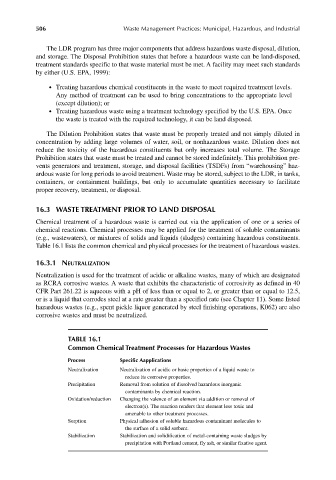
                       Table 16.1 lists the common chemical and physical processes for the treatment of hazardous wastes.

                       16.3.1 NEUTRALIZATION

                       Neutralization is used for the treatment of acidic or alkaline wastes, many of which are designated
                       as RCRA corrosive wastes. A waste that exhibits the characteristic of corrosivity as defined in 40
                       CFR Part 261.22 is aqueous with a pH of less than or equal to 2, or greater than or equal to 12.5,
                       or is a liquid that corrodes steel at a rate greater than a specified rate (see Chapter 11). Some listed
                       hazardous wastes (e.g., spent pickle liquor generated by steel finishing operations, K062) are also
                       corrosive wastes and must be neutralized.


                                TABLE 16.1
                                Common Chemical Treatment Processes for Hazardous Wastes

                                Process         Specific Aapplications
                                Neutralization  Neutralization of acidic or basic properties of a liquid waste to
                                                 reduce its corrosive properties.
                                Precipitation   Removal from solution of dissolved hazardous inorganic
                                                 contaminants by chemical reaction.
                                Oxidation/reduction  Changing the valence of an element via addition or removal of
                                                 electron(s). The reaction renders that element less toxic and
                                                 amenable to other treatment processes.
                                Sorption        Physical adhesion of soluble hazardous contaminant molecules to
                                                 the surface of a solid sorbent.
                                Stabilization   Stabilization and solidification of metal-containing waste sludges by
                                                 precipitation with Portland cement, fly ash, or similar fixative agent.

