


Page 320 - Wind Energy Handbook
P. 320
294                        DESIGN LOADS FOR HORIZONTAL-AXIS WIND TURBINES


          the shaft. For fixed hub machines, the loading on the shaft will include a significant
          moment arising from blade aerodynamic loads, but in the case of teetered two
          bladed rotors this moment will be virtually eliminated. In either case, however, the
          cantilevered low-speed shaft will experience large fluctuating moments due to rotor
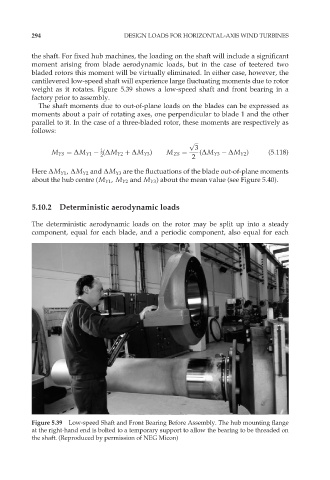
          weight as it rotates. Figure 5.39 shows a low-speed shaft and front bearing in a
          factory prior to assembly.
            The shaft moments due to out-of-plane loads on the blades can be expressed as
          moments about a pair of rotating axes, one perpendicular to blade 1 and the other
          parallel to it. In the case of a three-bladed rotor, these moments are respectively as
          follows:
                                                        p ffiffiffi
                                                         3
                              1
                M YS ¼ ˜M Y1   (˜M Y2 þ ˜M Y3 )  M ZS ¼    (˜M Y3   ˜M Y2 )   (5:118)
                              2                         2
          Here ˜M Y1 , ˜M Y2 and ˜M Y3 are the fluctuations of the blade out-of-plane moments
          about the hub centre (M Y1 , M Y2 and M Y3 ) about the mean value (see Figure 5.40).


          5.10.2 Deterministic aerodynamic loads

          The deterministic aerodynamic loads on the rotor may be split up into a steady
          component, equal for each blade, and a periodic component, also equal for each


          Figure 5.39 Low-speed Shaft and Front Bearing Before Assembly. The hub mounting flange
          at the right-hand end is bolted to a temporary support to allow the bearing to be threaded on
          the shaft. (Reproduced by permission of NEG Micon)

