


Page 131 - Wire Bonding in Microelectronics
P. 131
W ir e Bond Testing   109


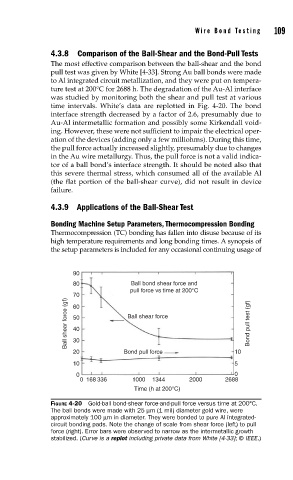
              4.3.8  Comparison of the Ball-Shear and the Bond-Pull Tests
              The most effective comparison between the ball-shear and the bond
              pull test was given by White [4-33]. Strong Au ball bonds were made
              to Al integrated circuit metallization, and they were put on tempera-
              ture test at 200°C for 2688 h. The degradation of the Au-Al interface
              was studied by monitoring both the shear and pull test at various
              time intervals. White’s data are replotted in Fig. 4-20. The bond
              interface strength decreased by a factor of 2.6, presumably due to
              Au-Al intermetallic formation and possibly some Kirkendall void-
              ing. However, these were not sufficient to impair the electrical oper-
              ation of the devices (adding only a few milliohms). During this time,
              the pull force actually increased slightly, presumably due to changes
              in the Au wire metallurgy. Thus, the pull force is not a valid indica-
              tor of a ball bond’s interface strength. It should be noted also that
              this severe thermal stress, which consumed all of the available Al
              (the flat portion of the ball-shear curve), did not result in device
              failure.

              4.3.9  Applications of the Ball-Shear Test

              Bonding Machine Setup Parameters, Thermocompression Bonding
              Thermocompression (TC) bonding has fallen into disuse because of its
              high temperature requirements and long bonding times. A synopsis of
              the setup parameters is included for any occasional continuing usage of


                    90
                    80              Ball bond shear force and
                                    pull force vs time at 200°C
                    70
                  Ball shear force (gf)  50  Ball shear force       Bond pull test (gf)
                    60

                    40
                    30
                    20            Bond pull force               10
                    10                                          5
                     0                                          0
                      0 168 336     1000  1344      2000      2688
                                     Time (h at 200°C)

              FIGURE 4-20  Gold-ball bond-shear force-and-pull force versus time at 200°C.
              The ball bonds were made with 25 µm (1 mil) diameter gold wire, were
              approximately 100 µm in diameter. They were bonded to pure Al integrated-
              circuit bonding pads. Note the change of scale from shear force (left) to pull
              force (right). Error bars were observed to narrow as the intermetallic growth
              stabilized. (Curve is a replot including private data from White [4-33]; © IEEE.)

