


Page 135 - Wire Bonding in Microelectronics
P. 135
W ir e Bond Testing   113


                   28  Bond shear force and pull force
                       vs. bond deformation for aluminum
                       wedge bonds
                   24

                   20
                 Force (gf)  16


                   12

                    8
                         Bond pull test
                    4    Shear test, unpulled bonds
                         Shear test on wedge after pulling
                    0
                         Low              Medium              High
                      deformation        deformation       deformation
                         1.4                1.8               2.8
                                   Deformation (wire diameters)

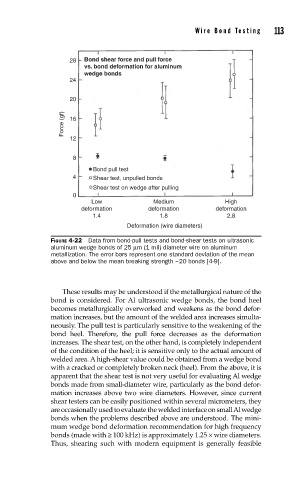
              FIGURE 4-22  Data from bond-pull tests and bond-shear tests on ultrasonic
              aluminum wedge bonds of 25 µm (1 mil) diameter wire on aluminum
              metallization. The error bars represent one standard deviation of the mean
              above and below the mean breaking strength ~20 bonds [4-9].


                 These results may be understood if the metallurgical nature of the
              bond is considered. For Al ultrasonic wedge bonds, the bond heel
              becomes metallurgically overworked and weakens as the bond defor-
              mation increases, but the amount of the welded area increases simulta-
              neously. The pull test is particularly sensitive to the weakening of the
              bond heel. Therefore, the pull force decreases as the deformation
              increases. The shear test, on the other hand, is completely independent
              of the condition of the heel; it is sensitive only to the actual amount of
              welded area. A high-shear value could be obtained from a wedge bond
              with a cracked or completely broken neck (heel). From the above, it is
              apparent that the shear test is not very useful for evaluating Al wedge
              bonds made from small-diameter wire, particularly as the bond defor-
              mation increases above two wire diameters. However,  since current
              shear testers can be easily positioned within several micrometers, they
              are occasionally used to evaluate the welded interface on small Al wedge
              bonds when the problems described above are understood. The mini-
              mum wedge bond deformation recommendation for high frequency
              bonds (made with ≥ 100 kHz) is approximately 1.25 × wire diameters.
              Thus, shearing such with modern equipment is generally feasible

