


Page 139 - Wire Bonding in Microelectronics
P. 139
W ir e Bond Testing   117


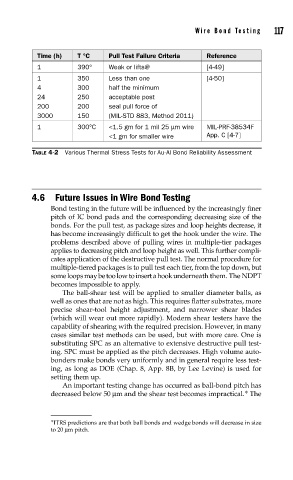
          Time (h)   T °C     Pull Test Failure Criteria  Reference
          1          390°     Weak or lifts@             [4-49]
          1          350      Less than one              [4-50]
          4          300      half the minimum
          24         250      acceptable post
          200        200      seal pull force of
          3000       150      (MIL-STD 883, Method 2011)
          1          300°C    <1.5 gm for 1 mil 25 µm wire  MIL-PRF-38534F
                              <1 gm for smaller wire     App. C [4-7]

         TABLE 4-2  Various Thermal Stress Tests for Au-Al Bond Reliability Assessment


         4.6  Future Issues in Wire Bond Testing
              Bond testing in the future will be influenced by the increasingly finer
              pitch of IC bond pads and the corresponding decreasing size of the
              bonds. For the pull test, as package sizes and loop heights decrease, it
              has become increasingly difficult to get the hook under the wire. The
              problems described above of pulling wires in multiple-tier packages
              applies to decreasing pitch and loop height as well. This further compli-
              cates application of the destructive pull test. The normal procedure for
              multiple-tiered packages is to pull test each tier, from the top down, but
              some loops may be too low to insert a hook un derneath them. The NDPT
              becomes impossible to apply.
                 The ball-shear test will be applied to smaller diameter balls, as
              well as ones that are not as high. This requires flatter substrates, more
              precise shear-tool height adjustment, and narrower shear blades
              (which will wear out more rapidly). Modern shear testers have the
              capability of shearing with the required precision. However, in many
              cases similar test methods can be used, but with more care. One is
              substituting SPC as an alternative to extensive destructive pull test-
              ing. SPC must be applied as the pitch decreases. High volume auto-
              bonders make bonds very uniformly and in general require less test-
              ing, as long as DOE (Chap. 8, App. 8B, by Lee Levine) is used for
              setting them up.
                 An important testing change has occurred as ball-bond pitch has
              decreased below 50 µm and the shear test becomes impractical. ∗  The


              ∗ ITRS predictions are that both ball bonds and wedge bonds will decrease in size
              to 20 µm pitch.

