


Page 145 - Wire Bonding in Microelectronics
P. 145
W ir e Bond Testing   123


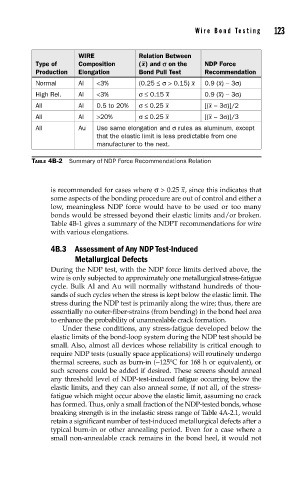
                     WIRE             Relation Between

          Type of    Composition      (x) and r on the   NDP Force
          Production  Elongation      Bond Pull Test    Recommendation

          Normal     Al   <3%         (0.25 ≤σ> 0.15) x    0.9 (x) − 3σ)

          High Rel.  Al   <3%         σ ≤ 0.15 x        0.9 (x) − 3σ)

          All        Al   0.5 to 20%  σ ≤ 0.25 x        [(x − 3σ)]/2

          All        Al   >20%        σ ≤ 0.25 x        [(x − 3σ)]/3
          All        Au     Use same elongation and σ rules as aluminum, except
                          that the elastic limit is less predictable from one
                          manufacturer to the next.


         TABLE 4B-2  Summary of NDP Force Recommendations Relation


                                                  –
              is recommended for cases where σ > 0.25 x, since this indicates that
              some aspects of the bonding procedure are out of control and either a
              low, meaningless NDP force would have to be used or too many
              bonds would be stressed beyond their elastic limits and/or broken.
              Table 4B-1 gives a summary of the NDPT recommendations for wire
              with various elongations.
              4B.3  Assessment of Any NDP Test-Induced
                    Metallurgical Defects
              During the NDP test, with the NDP force limits derived above, the
              wire is only subjected to approximately one metallurgical stress-fatigue
              cycle. Bulk Al and Au will normally withstand hundreds of thou-
              sands of such cycles when the stress is kept below the elastic limit. The
              stress during the NDP test is primarily along the wire; thus, there are
              essentially no outer-fiber-strains (from bending) in the bond heel area
              to enhance the probability of unannealable crack formation.
                 Under these conditions, any stress-fatigue developed below the
              elastic limits of the bond-loop system during the NDP test should be
              small. Also, almost all devices whose reliability is critical enough to
              require NDP tests (usually space applications) will routinely undergo
              thermal screens, such as burn-in (~125°C for 168 h or equivalent), or
              such screens could be added if desired. These screens should anneal
              any threshold level of NDP-test-induced fatigue occurring below the
              elastic limits, and they can also anneal some, if not all, of the stress-
              fatigue which might occur above the elastic limit, assuming no crack
              has formed. Thus, only a small fraction of the NDP-tested bonds, whose
              breaking strength is in the inelastic stress range of Table 4A-2.1, would
              retain a significant number of test-induced metallurgical defects after a
              typical burn-in or other annealing period. Even for a case where a
              small non-annealable crack remains in the bond heel, it would not

