


Page 457 - The ISA Handbook in Contemporary Sociology
P. 457
9781412934633-Chap-28  1/10/09  8:58 AM  Page 428


                   428               THE ISA HANDBOOK IN CONTEMPORARY SOCIOLOGY


                   stores in the southern USA), diminutives  although it should be noted that even deroga-
                   (‘Daddy’ instead of ‘Dad’). On the other  tive forms can be used as terms of endear-
                   hand, vocatives can also be used to express or  ment if negotiated by the speakers.
                   provoke conflict, as in ‘buster’ in the expres-  In order to emphasize the applicability of
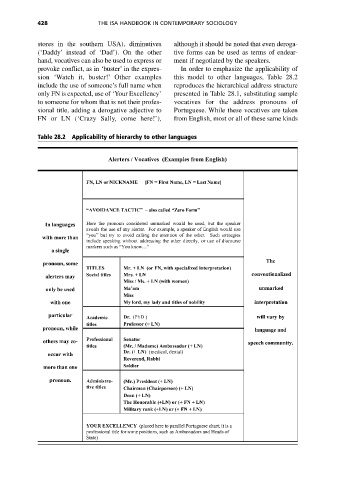
                   sion ‘Watch it, buster!’ Other examples  this model to other languages,  Table 28.2
                   include the use of someone’s full name when  reproduces the hierarchical address structure
                   only FN is expected, use of ‘Your Excellency’  presented in Table 28.1, substituting sample
                   to someone for whom that is not their profes-  vocatives for the address pronouns of
                   sional title, adding a derogative adjective to  Portuguese. While these vocatives are taken
                   FN or LN (‘Crazy Sally, come here!’),   from English, most or all of these same kinds

                   Table 28.2  Applicability of hierarchy to other languages

