


Page 371 - Advanced Organic Chemistry Part A - Structure and Mechanisms, 5th ed (2007) - Carey _ Sundberg
P. 371
352

     CHAPTER 3
     Structural Effects on
     Stability and Reactivity


                         k  obs                        uncatalyzed
                                                       reaction is
                                                       dominant
                               acid-catalyzed                                base-catalyzed
                               reaction is                                   reaction is
                               dominant                                      dominant


                          0    1   2    3   4    5   6    7   8    9   10   11  12   13  14
                                                          pH
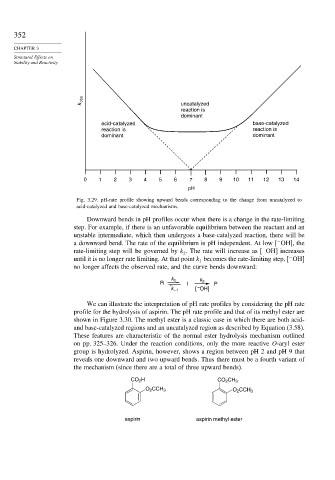
                        Fig. 3.29. pH-rate profile showing upward bends corresponding to the change from uncatalyzed to
                        acid-catalyzed and base-catalyzed mechanisms.

                           Downward bends in pH profiles occur when there is a change in the rate-limiting
                       step. For example, if there is an unfavorable equilibrium between the reactant and an
                       unstable intermediate, which then undergoes a base-catalyzed reaction, there will be
                                                                                    −
                       a downward bend. The rate of the equilibrium is pH independent. At low   OH , the
                       rate-limiting step will be governed by k . The rate will increase as   OH  increases
                                                                                −
                                                        2
                       until it is no longer rate limiting. At that point k becomes the rate-limiting step,   OH
                                                                                        −
                                                             1
                       no longer affects the observed rate, and the curve bends downward:
                                                    k        k
                                                 R   1   I    2  P
                                                            –
                                                    k  –1   [  OH]
                           We can illustrate the interpretation of pH rate profiles by considering the pH rate
                       profile for the hydrolysis of aspirin. The pH rate profile and that of its methyl ester are
                       shown in Figure 3.30. The methyl ester is a classic case in which there are both acid-
                       and base-catalyzed regions and an uncatalyzed region as described by Equation (3.58).
                       These features are characteristic of the normal ester hydrolysis mechanism outlined
                       on pp. 325–326. Under the reaction conditions, only the more reactive O-aryl ester
                       group is hydrolyzed. Aspirin, however, shows a region between pH 2 and pH 9 that
                       reveals one downward and two upward bends. Thus there must be a fourth variant of
                       the mechanism (since there are a total of three upward bends).

                                        CO 2 H                    CO 2 CH 3
                                             O 2 CCH 3                 O 2 CCH 3


                                      aspirin               aspirin methyl ester

