


Page 1181 - Advanced Organic Chemistry Part B - Reactions & Synthesis
P. 1181
12.9. A method for oxidative cleavage of cyclic ketones involves a four-stage   1157
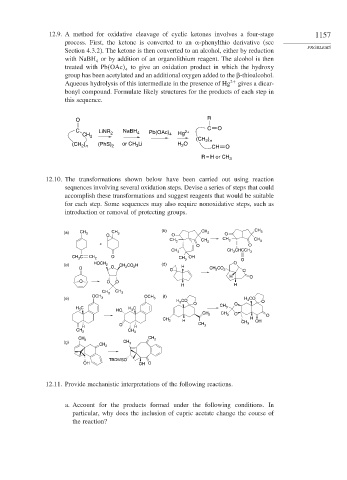
                    process. First, the ketone is converted to an  -phenylthio derivative (see
                                                                                             PROBLEMS
                    Section 4.3.2). The ketone is then converted to an alcohol, either by reduction
                    with NaBH or by addition of an organolithium reagent. The alcohol is then
                              4
                    treated with Pb OAc  to give an oxidation product in which the hydroxy
                                       4
                    group has been acetylated and an additional oxygen added to the
-thioalcohol.
                    Aqueous hydrolysis of this intermediate in the presence of Hg 2+  gives a dicar-
                    bonyl compound. Formulate likely structures for the products of each step in
                    this sequence.


                        O                                      R
                                                               C  O
                        C      LiNR 2  NaBH 4  Pb(OAc)   2+
                          CH 2                      4  Hg
                                                            (CH )
                                                               2 n
                          )   (PhS)   or CH Li        H O
                       (CH 2 n     2      3            2         CH  O
                                                              R = H or CH 3
               12.10. The transformations shown below have been carried out using reaction
                    sequences involving several oxidation steps. Devise a series of steps that could
                    accomplish these transformations and suggest reagents that would be suitable
                    for each step. Some sequences may also require nonoxidative steps, such as
                    introduction or removal of protecting groups.


                                                  (b)                        CH 3
                    (a)  CH 3      CH 3                      CH 3   O
                                 O                   O
                                                                    CH 3
                                                    CH 3     CH 3            CH 3
                                                            O               O
                                                    CH 3             CH 3 CHCCH 3
                       CH 3 C  CH 2  O                    OH
                                                       CH 3              O
                    (c)      HOCH 2  CH 2 CO 2 H  (d)  H               O
                         O        O                             CH 3 CO 2
                                                    O                     O
                                                                      H     O
                         O       O  O
                                                       H               H
                                CH 3  CH 3
                                                  (f)
                             OCH 3
                    (e)                     OCH 3                         H 3 CO
                                                      H 3 CO                    O
                                                           O           O
                        H 3 C          H 3 C                       CH 3
                                    HO
                                                                       O
                                                              CH 2  CH 3         O
                                                                            H
                                                  CH 3  H                CH 3  OH
                          H          O   H                   CH 3
                        CH 2           CH 3
                         CH 3                 CH 2
                    (g)               CH 3
                               CH 2
                                  TBDMSO
                          OH               OH O
               12.11. Provide mechanistic interpretations of the following reactions.
                     a. Account for the products formed under the following conditions. In
                       particular, why does the inclusion of cupric acetate change the course of
                       the reaction?

