


Page 210 - Analysis and Design of Machine Elements
P. 210
188
                       Analysis and Design of Machine Elements
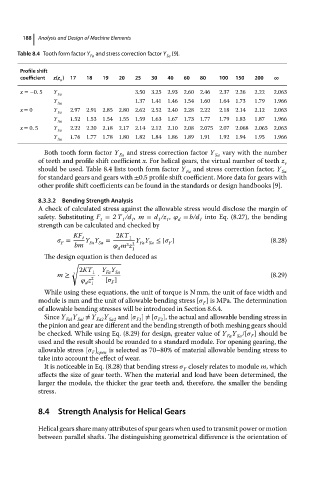
                 Table 8.4 Tooth form factor Y and stress correction factor Y  Sa  [9].
                                      Fa
                  Profile shift
                  coefficient  z(z )  17  18  19  20  25  30   40  60   80    100  150  200  ∞
                              v
                  x =−0. 5  Y  Fa                  3.50  3.25  2.93  2.60  2.46  2.37  2.26  2.22  2.063
                            Y  Sa                  1.37  1.41  1.46  1.54  1.60  1.64  1.73  1.79  1.966
                  x = 0     Y  Fa  2.97  2.91  2.85  2.80  2.62  2.52  2.40  2.28  2.22  2.18  2.14  2.12  2.063
                            Y  Sa  1.52  1.53  1.54  1.55  1.59  1.63  1.67  1.73  1.77  1.79  1.83  1.87  1.966
                  x = 0. 5  Y  Fa  2.22  2.20  2.18  2.17  2.14  2.12  2.10  2.08  2.075  2.07  2.068  2.065  2.063
                            Y  Sa  1.76  1.77  1.78  1.80  1.82  1.84  1.86  1.89  1.91  1.92  1.94  1.95  1.966

                         Both tooth form factor Y  Fa  and stress correction factor Y  Sa  vary with the number
                       of teeth and profile shift coefficient x. For helical gears, the virtual number of teeth z
                                                                                              v
                       should be used. Table 8.4 lists tooth form factor Y  and stress correction factor, Y
                                                                  Fa                          Sa
                       for standard gears and gears with ±0.5 profile shift coefficient. More data for gears with
                       other profile shift coefficients can be found in the standards or design handbooks [9].
                       8.3.3.2  Bending Strength Analysis
                       A check of calculated stress against the allowable stress would disclose the margin of
                       safety. Substituting F = 2T /d ,m = d /z ,    = b/d into Eq. (8.27), the bending
                                         t      1  1      1  1  d     1
                       strength can be calculated and checked by
                                  KF          2KT
                                =   t  Y Y  =     1  Y Y  ≤ [   ]                         (8.28)
                              F
                                                 3 2
                                  bm  Fa Sa     m z 1  Fa Sa  F
                                              d
                         The design equation is then deduced as
                                 √
                                   2KT 1  Y Y
                                           Fa Sa
                             m ≥  3     ⋅                                                 (8.29)
                                       z 2  [   ]
                                            F
                                     d 1
                         While using these equations, the unit of torque is N mm, the unit of face width and
                       module is mm and the unit of allowable bending stress [   ] is MPa. The determination
                                                                       F
                       of allowable bending stresses will be introduced in Section 8.6.4.
                         Since Y  Y  ≠ Y  Y   and [   ] ≠ [   ], the actual and allowable bending stress in
                               Fal  Sal  Fa2  Sa2   F1    F2
                       the pinion and gear are different and the bending strength of both meshing gears should
                       be checked. While using Eq. (8.29) for design, greater value of Y Y /[   ] should be
                                                                                 Sa
                                                                              Fa
                                                                                     F
                       used and the result should be rounded to a standard module. For opening gearing, the
                       allowablestress[   ]  is selected as 70–80% of material allowable bending stress to
                                       F open
                       take into accountthe effectofwear.
                         It is noticeable in Eq. (8.28) that bending stress    closely relates to module m,which
                                                                 F
                       affects the size of gear teeth. When the material and load have been determined, the
                       larger the module, the thicker the gear teeth and, therefore, the smaller the bending
                       stress.
                       8.4 Strength Analysis for Helical Gears
                       Helical gears share many attributes of spur gears when used to transmit power or motion
                       between parallel shafts. The distinguishing geometrical difference is the orientation of

