


Page 102 - Analytical Electrochemistry 2d Ed - Jospeh Wang
P. 102
3-6  FLOW ANALYSIS                                               87

            3-6.1  Principles
            Electrochemical detection is usually performed by controlling the potential of the
            working electrode at a ®xed value (corresponding to the limiting current plateau
            region of the compounds of interest) and monitoring the current as a function of
            time. The current response thus generated re¯ects the concentration pro®les of these
            compounds as they pass through the detector. Detection for liquid chromatography
            or ¯ow injection systems results in sharp current peaks (re¯ecting the passage of the
            eluted analyte or sample zone, respectively). Accordingly, the magnitude of the peak
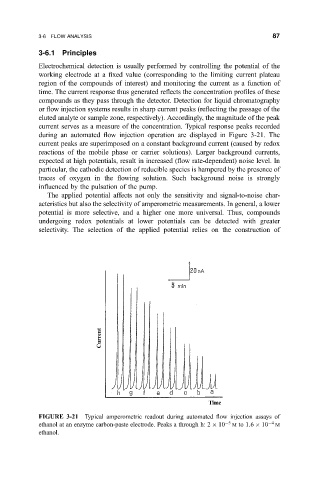
            current serves as a measure of the concentration. Typical response peaks recorded
            during an automated ¯ow injection operation are displayed in Figure 3-21. The
            current peaks are superimposed on a constant background current (caused by redox
            reactions of the mobile phase or carrier solutions). Larger background currents,
            expected at high potentials, result in increased (¯ow rate-dependent) noise level. In
            particular, the cathodic detection of reducible species is hampered by the presence of
            traces of oxygen in the ¯owing solution. Such background noise is strongly
            in¯uenced by the pulsation of the pump.
              The applied potential affects not only the sensitivity and signal-to-noise char-
            acteristics but also the selectivity of amperometric measurements. In general, a lower
            potential is more selective, and a higher one more universal. Thus, compounds
            undergoing redox potentials at lower potentials can be detected with greater
            selectivity. The selection of the applied potential relies on the construction of


            FIGURE 3-21  Typical amperometric readout during automated ¯ow injection assays of
            ethanol at an enzyme carbon-paste electrode. Peaks a through h: 2   10  5  M to 1:6   10  4  M
            ethanol.

