


Page 104 - Analytical Electrochemistry 2d Ed - Jospeh Wang
P. 104
3-6  FLOW ANALYSIS                                               89

            rectangular channel. The ¯ow channel is formed by two plastic blocks pressing a
            thin Te¯on gasket, which de®nes the very small dead volume ( 1 mL). In the wall-jet
            design, the stream ¯ows from a nozzle perpendicularly onto a ¯at electrode surface
            (the wall), and then spreads radially over the surface. The electrode diameter is
            signi®cantly larger than that of the nozzle inlet. Since the jet remains intact up to
            quite large inlet±electrode separations, it is possible to employ large-volume wall-jet
            detectors that offer decreased sensitivity to the properties of the mobile phase and
            simpli®ed fabrication.
              It is possible to employ detectors with solutions ¯owing over a static mercury
            drop electrode or a carbon-®ber microelectrode, or to use ¯ow-through electrodes,
            with the electrode simply an open tube or porous matrix. The latter can offer
            complete electrolysis, that is coulometric detection. The extremely small dimensions
            of ultramicroelectrodes (discussed in Section 4-5.4) offer the advantages of ¯ow rate
            independence (and hence a low noise level) and operation in nonconductive mobile
            phases (such as those of normal-phase chromatography or supercritical ¯uid
            chromatography). Ultramicroelectrodes can also greatly bene®t modern microse-
            paration techniques such as open-tubular liquid chromatography or capillary zone
            electrophoresis (CZE) (57). For example, cylindrical-shaped carbon or copper ®bers
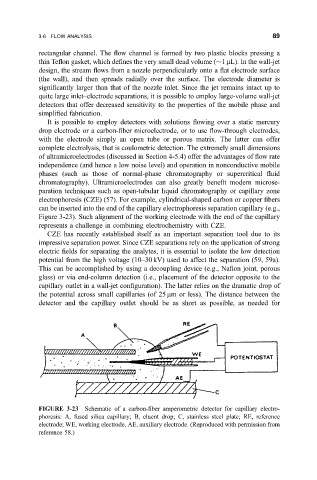
            can be inserted into the end of the capillary electrophoresis separation capillary (e.g.,
            Figure 3-23). Such alignment of the working electrode with the end of the capillary
            represents a challenge in combining electrochemistry with CZE.
              CZE has recently established itself as an important separation tool due to its
            impressive separation power. Since CZE separations rely on the application of strong
            electric ®elds for separating the analytes, it is essential to isolate the low detection
            potential from the high voltage (10±30 kV) used to affect the separation (59, 59a).
            This can be accomplished by using a decoupling device (e.g., Na®on joint, porous
            glass) or via end-column detection (i.e., placement of the detector opposite to the
            capillary outlet in a wall-jet con®guration). The latter relies on the dramatic drop of
            the potential across small capillaries (of 25 mm or less). The distance between the
            detector and the capillary outlet should be as short as possible, as needed for


            FIGURE 3-23 Schematic of a carbon-®ber amperometric detector for capillary electro-
            phoresis: A, fused silica capillary; B, eluent drop; C, stainless steel plate; RE, reference
            electrode; WE, working electrode, AE, auxiliary electrode. (Reproduced with permission from
            reference 58.)

