


Page 441 - Applied Numerical Methods Using MATLAB
P. 441
430    PARTIAL DIFFERENTIAL EQUATIONS
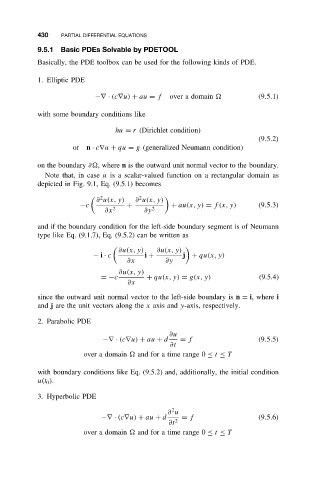
           9.5.1  Basic PDEs Solvable by PDETOOL
           Basically, the PDE toolbox can be used for the following kinds of PDE.

           1. Elliptic PDE

                           −∇ · (c∇u) + au = f  over a domain            (9.5.1)

           with some boundary conditions like

                                 hu = r(Dirichlet condition)
                                                                         (9.5.2)
                     or  n · c∇u + qu = g(generalized Neumann condition)

           on the boundary ∂ ,where n is the outward unit normal vector to the boundary.
             Note that, in case u is a scalar-valued function on a rectangular domain as
           depicted in Fig. 9.1, Eq. (9.5.1) becomes

                            ∂ u(x, y)  ∂ u(x, y)
                             2          2
                       −c           +            + au(x, y) = f (x, y)   (9.5.3)
                              ∂x 2       ∂y 2
           and if the boundary condition for the left-side boundary segment is of Neumann
           type like Eq. (9.1.7), Eq. (9.5.2) can be written as

                                  ∂u(x, y)  ∂u(x, y)

                           − i · c       i +        j + qu(x, y)
                                    ∂x         ∂y
                                  ∂u(x, y)
                             =−c          + qu(x, y) = g(x, y)           (9.5.4)
                                    ∂x
           since the outward unit normal vector to the left-side boundary is n = i,where i
           and j are the unit vectors along the x axis and y-axis, respectively.

           2. Parabolic PDE

                                                ∂u
                              −∇ · (c∇u) + au + d  = f                   (9.5.5)
                                                ∂t
                        over a domain   and for a time range 0 ≤ t ≤ T

           with boundary conditions like Eq. (9.5.2) and, additionally, the initial condition
           u(t 0 ).
           3. Hyperbolic PDE

                                                 2
                                                ∂ u
                             −∇ · (c∇u) + au + d   = f                   (9.5.6)
                                                ∂t 2
                        over a domain   and for a time range 0 ≤ t ≤ T

