


Page 398 - Applied Statistics And Probability For Engineers
P. 398
c10.qxd  5/16/02  1:31 PM  Page 342 RK UL 6 RK UL 6:Desktop Folder:TEMP WORK:MONTGOMERY:REVISES UPLO D CH114 FIN L:Quark Files:


               342     CHAPTER 10 STATISTICAL INFERENCE FOR TWO SAMPLES


                                                               *
                                                              T     X 1   X 2    0                (10-15)
                                                               0
                                                                      S 2 1  S 2 2
                                                                      n     n
                                                                    B 1     2


                                 is distributed approximately as t with degrees of freedom given by


                                                                     2    2 2
                                                                    S 1  S 2
                                                                   a       b
                                                                    n 1  n 2
                                                            v     2   2    2   2                  (10-16)
                                                                1S n 2     1S n 2
                                                                           2
 2
                                                                  1
 1
                                                                n   1     n   1
                                                                 1
                                                                           2
                                            2
                                                2
                                 Therefore, if       , the hypotheses on differences in the means of two normal distributions are
                                            1
                                                2
                                                                       *
                                 tested as in the equal variances case, except that T is used as the test statistic and n 1   n 2   2 is
                                                                       0
                                 replaced by v in determining the degrees of freedom for the test.
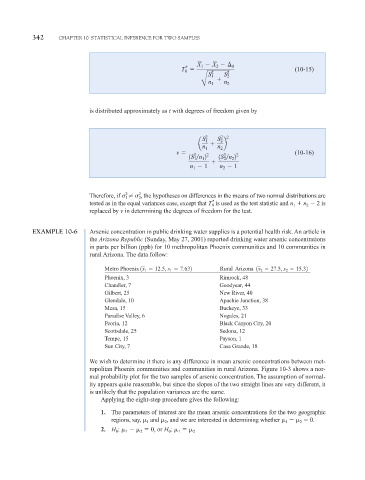
               EXAMPLE 10-6      Arsenic concentration in public drinking water supplies is a potential health risk. An article in
                                 the Arizona Republic (Sunday, May 27, 2001) reported drinking water arsenic concentrations
                                 in parts per billion (ppb) for 10 methropolitan Phoenix communities and 10 communities in
                                 rural Arizona. The data follow:

                                      Metro Phoenix 1x 1   12.5, s 1   7.632  Rural Arizona  1x 2   27.5, s 2   15.32
                                      Phoenix, 3                          Rimrock, 48
                                      Chandler, 7                         Goodyear, 44
                                      Gilbert, 25                         New River, 40
                                      Glendale, 10                        Apachie Junction, 38
                                      Mesa, 15                            Buckeye, 33
                                      Paradise Valley, 6                  Nogales, 21
                                      Peoria, 12                          Black Canyon City, 20
                                      Scottsdale, 25                      Sedona, 12
                                      Tempe, 15                           Payson, 1
                                      Sun City, 7                         Casa Grande, 18

                                 We wish to determine it there is any difference in mean arsenic concentrations between met-
                                 ropolitan Phoenix communities and communities in rural Arizona. Figure 10-3 shows a nor-
                                 mal probability plot for the two samples of arsenic concentration. The assumption of normal-
                                 ity appears quite reasonable, but since the slopes of the two straight lines are very different, it
                                 is unlikely that the population variances are the same.
                                    Applying the eight-step procedure gives the following:

                                    1. The parameters of interest are the mean arsenic concentrations for the two geographic
                                        regions, say,   1 and   2 , and we are interested in determining whether   1     2   0.

                                    2. H 0 :   1     2   0, or H 0 :   1     2

