


Page 400 - Applied Statistics And Probability For Engineers
P. 400
c10.qxd  5/16/02  1:31 PM  Page 344 RK UL 6 RK UL 6:Desktop Folder:TEMP WORK:MONTGOMERY:REVISES UPLO D CH114 FIN L:Quark Files:


               344     CHAPTER 10 STATISTICAL INFERENCE FOR TWO SAMPLES


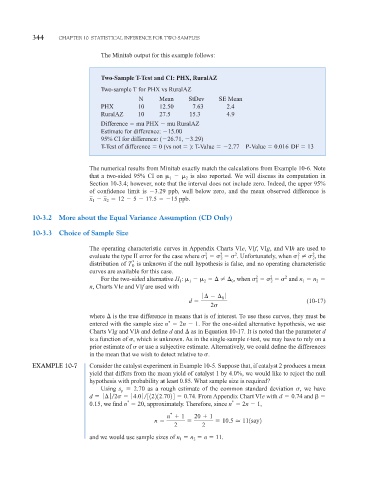
                                    The Minitab output for this example follows:


                                    Two-Sample T-Test and CI: PHX, RuralAZ
                                    Two-sample T for PHX vs RuralAZ
                                                N      Mean     StDev     SE Mean
                                    PHX         10     12.50     7.63       2.4
                                    RuralAZ     10     27.5     15.3        4.9
                                    Difference   mu PHX   mu RuralAZ
                                    Estimate for difference:  15.00
                                    95% CI for difference: ( 26.71,  3.29)
                                    T-Test of difference   0 (vs not   ): T-Value    2.77  P-Value   0.016 DF   13


                                 The numerical results from Minitab exactly match the calculations from Example 10-6. Note
                                 that a two-sided 95% CI on   1     2 is also reported. We will discuss its computation in
                                 Section 10-3.4; however, note that the interval does not include zero. Indeed, the upper 95%
                                 of confidence limit is  3.29 ppb, well below zero, and the mean observed difference is
                                 x   x   12   5   17.5   15 ppb .
                                  1
                                      2
               10-3.2  More about the Equal Variance Assumption (CD Only)


               10-3.3  Choice of Sample Size

                                 The operating characteristic curves in Appendix Charts VIe, VIf, VIg, and VIh are used to
                                                                     2
                                                                          2
                                                                                                  2
                                                                                                       2
                                                                               2
                                 evaluate the type II error for the case where          . Unfortunately, when       , the
                                                                                                  1
                                                                     1
                                                                                                       2
                                                                          2
                                              *
                                 distribution of T 0  is unknown if the null hypothesis is false, and no operating characteristic
                                 curves are available for this case.
                                                                                     2
                                                                                              2
                                                                                          2
                                    For the two-sided alternative H 1 :   1     2         0 , when           and n 1   n 2
                                                                                     1
                                                                                          2
                                 n, Charts VIe and VIf are used with
                                                                    ƒ     ƒ
                                                                           0
                                                                d                                    (10-17)
                                                                       2
                                 where   is the true difference in means that is of interest. To use these curves, they must be
                                 entered with the sample size n *    2n   1. For the one-sided alternative hypothesis, we use
                                 Charts VIg and VIh and define d and   as in Equation 10-17. It is noted that the parameter d
                                 is a function of  , which is unknown. As in the single-sample t-test, we may have to rely on a
                                 prior estimate of   or use a subjective estimate. Alternatively, we could define the differences
                                 in the mean that we wish to detect relative to  .
               EXAMPLE 10-7      Consider the catalyst experiment in Example 10-5. Suppose that, if catalyst 2 produces a mean
                                 yield that differs from the mean yield of catalyst 1 by 4.0%, we would like to reject the null
                                 hypothesis with probability at least 0.85. What sample size is required?
                                    Using  s p    2.70 as a rough estimate of the common standard deviation  , we have
                                 d   ƒ   ƒ
2   ƒ 4.0 ƒ
 312212.7024   0.74.  From Appendix Chart VIe with d   0.74 and
                                             *
                                                                              *
                                 0.15, we find n   20, approximately. Therefore, since n   2n   1,
                                                          *
                                                         n   1    20   1
                                                     n                    10.5   111say2
                                                           2        2
                                 and we would use sample sizes of n 1   n 2   n   11.

