


Page 198 - Applied statistics and probability for engineers
P. 198
176     Chapter 5/Joint Probability Distributions


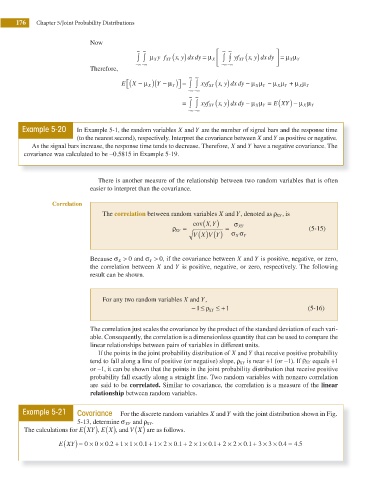
                                   Now
                                                 ∞  ∞                    ⎡  ∞  ∞          ⎤
                                                               )
                                                                                     )
                                                 ∫  ∫  μ X y f XY  (x, y dxdy  = μ X  ⎢ ∫  ∫  yf XY  (x, y dxdy  ⎥  = μ μ Y
                                                                                               X
                                                −∞  − −∞                 ⎣ −∞ −∞          ⎦
                                   Therefore,
                                                                            )
                                            E ( ⎡ ⎣  X − μ )( Y − μ )⎤ =  ∞ ∫  ∞ ∫  xyf XY ( x, y dx dy  − μ X μ − μ μ + μ μ  Y
                                                             ⎦
                                                           Y
                                                                                      Y
                                                    X
                                                                                             Y
                                                                                                 X
                                                                                           X
                                                                −∞  −∞
                                                                ∞  ∞
                                                                            )
                                                              =  ∫  ∫  x xyf XY ( x, y dx dy  − μ X μ = (  X  Y
                                                                                          E XY) − μ μ
                                                                                      Y
                                                                −∞  −∞
              Example 5-20     In Example 5-1, the random variables X and Y are the number of signal bars and the response time
                               (to the nearest second), respectively. Interpret the covariance between X and Y as positive or negative.
                 As the signal bars increase, the response time tends to decrease. Therefore, X and Y have a negative covariance. The
               covariance was calculated to be −0.5815 in Example 5-19.
                                     There is another measure of the relationship between two random variables that is often
                                   easier to interpret than the covariance.
                       Correlation
                                      The correlation between random variables X and Y, denoted as ρ XY , is
                                                                  cov    (X,Y )  σ XY
                                                           ρ XY  =         =                        (5-15)
                                                                   ( ) ( )
                                                                 V X V Y     σ σ Y
                                                                              X
                                   Because σ X > 0 and σ Y > 0, if the covariance between X and Y is positive, negative, or zero,
                                   the correlation between X  and Y  is positive, negative, or zero, respectively. The following
                                   result can be shown.


                                      For any two random variables X and Y,
                                                                 − Ð ρ XY  ≤ +1                     (5-16)
                                                                   1

                                   The correlation just scales the covariance by the product of the standard deviation of each vari-
                                   able. Consequently, the correlation is a dimensionless quantity that can be used to compare the
                                   linear relationships between pairs of variables in different units.
                                     If the points in the joint probability distribution of X and Y that receive positive probability
                                   tend to fall along a line of positive (or negative) slope, ρ XY  is near +1 (or −1). If  ρ XY equals +1
                                   or −1, it can be shown that the points in the joint probability distribution that receive positive
                                   probability fall exactly along a straight line. Two random variables with nonzero correlation
                                   are said to be correlated. Similar to covariance, the correlation is a measure of the linear
                                   relationship between random variables.


              Example 5-21     Covariance  For the discrete random variables X and Y with the joint distribution shown in Fig.
                               5-13, determine σ XY  and ρ XY .
                                 (
               The calculations for E XY), E X ( ), and V X ( ) are as follows.
                           (
                                                                                             4
                                                                                                4
                                                                                  1
                                                                                     3
                                                                                           0
                                                                                        3
                                              1
                                                 0
                                                   1
                                            1
                         E XY) = 0  × 0  × . + × × . + × 2  × . + 2  × × . + 2  × 2  × . + × × . = .5
                                       0
                                         2
                                                                      0
                                                                        1
                                                                                 0
                                                                   1
                                                      1
                                                            0
                                                             1

