


Page 208 - Bebop to The Boolean Boogie An Unconventional Guide to Electronics Fundamentals, Components, and Processes
P. 208
Programmable ICs      189

            flops, but alternative register types such as JK flip-flops or T-type flip-flops may

            be more suitable for certain applications. It can be inconvenient to support a
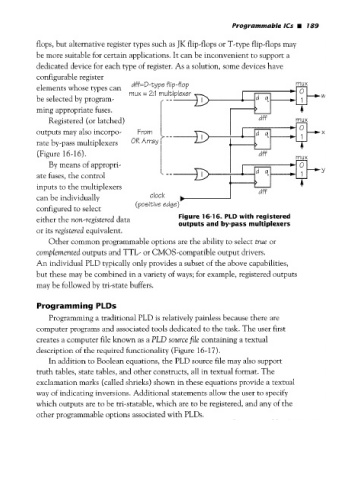
            dedicated device for each type of register. As a solution, some devices have
            configurable register
                                        dff=D-type flip-flop                            rn ux
            elements whose types can
            be selected by prograrn-                                                            w
                  appropriate fuses.
                 egistered (or latched)
            outputs may also incorpo-     From   ’                                              X
            rate by-pass multiplexers   OR *rray
            (Figure 16-16).
                By means of appropri-
                                                                                                Y
            ate fuses, the control
            inputs to the multiplexers
            can be individually
                                         (positive edge)
            configured to select
            either the non-registered data            Figure 16-1 6. PLD with registered
                                                      outputs and by-pass multiplexers
            or its registered equivalent+
                Other common programmable options are the ability to select true or
            complemented outputs and TTL- or CMOS-compatible output drivers.
            An individual PLD typically only provides a subset of the above capabilities,
            but these may be combined in a variety of ways; for example, registered outputs
            may be followed by tri-state buffers.


            Programming PLDs
                Programming a traditional PLD is relatively painless because there are
            computer programs and associated tools dedicated to the task. The user first
            creates a computer file known as a PLD source file containing a textual
            description of the required functionality (Figure 16- 17).
                In addition to Boolean equations, the PLD source file may also support
            truth tables, state tables, and other constructs, all in textual format. The
            exclamation marks (called shrieks) shown in these equations provide a textual
            way of indicating inversions. Additional statements allow the user to specify
            which outputs are to be tri-statable, which are to be registered, and any of the
            other programmable options associated with PLDs.

