


Page 210 - Bebop to The Boolean Boogie An Unconventional Guide to Electronics Fundamentals, Components, and Processes
P. 210
Programmable ICs      19 1

                 As an alternative to the user specifying a particular device, the program can
             be instructed to automatically select the best device for the task. The program
             can base its selection on a variety of criteria, such as the speed, cost, and power
             consumption of the devices. The program may also be used to partition a large
             design across several devices, in which case it will output a separate JEDEC file
             for each device.
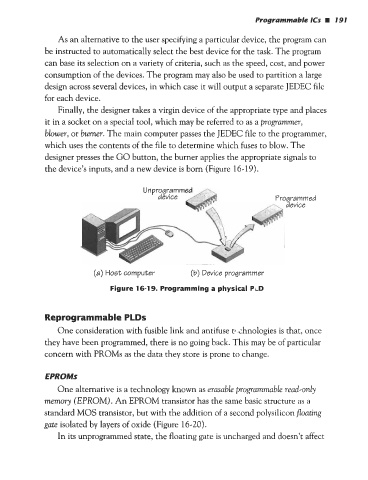
                 Finally, the designer takes a virgin device of the appropriate type and places
             it in a socket on a special tool, which may be referred to as a programmer,
             blower, or burner. The main computer passes the JEDEC file to the programmer,
             which uses the contents of the file to determine which fuses to blow. The
             designer presses the GO button, the burner applies the appropriate signals to
             the device’s inputs, and a new device is born (Figure 16-19).


                           (a)  Host computer        (b)  Device programmer
                               Figure 16-19. Programming a physical PLD


             Reprogrammable PLDs

                 One consideration with fusible link and antifuse ti .ihnologies is that, once
             they have been programmed, there is no going back. This may be of particular
             concern with PROMS as the data they store is prone to change.

             EPROMs

                 One alternative is a technology known as erasable programmable read-only
             memory (EPROM). An EPROM transistor has the same basic structure as a
             standard MOS transistor, but with the addition of a second polysilicon floating
             gate isolated by layers of oxide (Figure 16-20).

                 In its unprogrammed state, the floating gate is uncharged and doesn’t affect

