


Page 213 - Bebop to The Boolean Boogie An Unconventional Guide to Electronics Fundamentals, Components, and Processes
P. 213
194     Chapter Sixteen

                In-System Programmable

                    One advantage of E2PROM and FLASH devices is that they can be repro-
                grammed while still on the circuit board, in which case they may be referred to
                as in-system pogramdle (ISP).14 A large proportion of FLASH and E2PROM

                devices use hot (high energy) electron injection similar to EPROM and require
                12V signals for programming. Some designers see this as an advantage, because
                these devices cannot be accidentally erased by means of the 5.0V (or lower,
                such as 3.3V, 3.0V, etc.) signals used during the circuit’s normal operation.
                However, an increasing number of devices use cold (low energy) Fowler-
                Nordheim electron tunneling and can be programmed using the standard signal
                voltage (5.0V, 3.3V, 3.0V, etc.).
                    In addition to their use as memories, EPROM, E2PROM, and FLASH

                technologies are also employed in other PLD types, which are generically
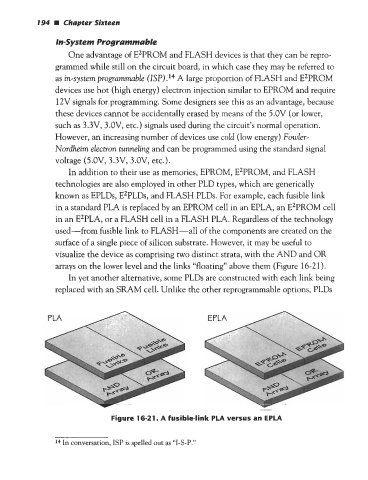
                known as EPLDs, E2PLDs, and FLASH PLDs. For example, each fusible link
                in a standard PLA is replaced by an EPROM cell in an EPLA, an E2PROM cell
                in an E2PLA, or a FLASH cell in a FLASH PLA. Regardless of the technology
                used-from   fusible link to FLASH-all  of the components are created on the
                surface of a single piece of silicon substrate. However, it may be useful to
                visualize the device as comprising two distinct strata, with the AND and OR

                arrays on the lower level and the links “floating” above them (Figure 16-2 1).
                    In yet another alternative, some PLDs are constructed with each link being
                replaced with an SRAM cell. Unlike the other reprogrammable options, PLDs


                                Figure 16-21. A fusible-link PLA versus an EPLA


                14 In conversation, ISP is spelled out as “I-S-P.”

