


Page 209 - Bebop to The Boolean Boogie An Unconventional Guide to Electronics Fundamentals, Components, and Processes
P. 209
7 90   Chapter Sixteen


                         /
                            INPUT      =   a, b, G;

                            OUTPUT     =   w , x  , y ;
                            EQUATION w      =  (a & b)  ;
                            EQUATION x      =  (a & b)  I  (a &  !b  &  !G) ;
                            EQUATION y      =  (a & b)  I  (b & G) I (a  &  !G) ;


                            Figure 16-1 7. Very simple example PLD source file

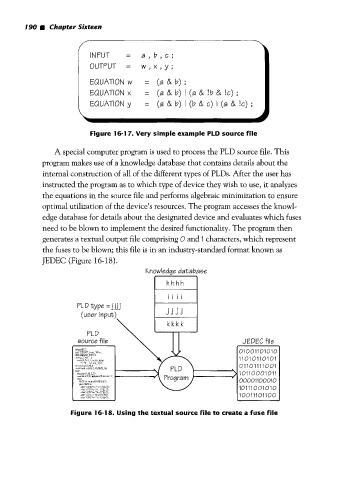
                 A special computer program is used to process the PLD source file. This
              program makes use of a knowledge database that contains details about the
              internal construction of all of the different types of PLDs. After the user has
              instructed the program as to which type of device they wish to use, it analyzes
              the equations in the source file and performs algebraic minimization to ensure
              optimal utilization of the device’s resources. The program accesses the knowl-
              edge database for details about the designated device and evaluates which fuses
              need to be blown to implement the desired functionality. The program then

              generates a textual output file comprising O and I  characters, which represent
              the fuses to be blown; this file is in an industry-standard format known as
              JEDEC (Figure 16-1 8).
                                            Knowledqe database


                                                                        11 01 01 101 01
                                                                        01101111001
                                                                        10110001011
                                                                        00001100010


                      Figure 16-18. Using the textual source file to create a fuse file

