


Page 211 - Bebop to The Boolean Boogie An Unconventional Guide to Electronics Fundamentals, Components, and Processes
P. 211
192 w  Chapter Sixteen

                                                            Source      Control gate    Drain
           Source      Control gate    Drain                terminal     terminal      terminal
           terminal     terminal      terminal                              I
                                                  Silicon -
              I            I             I
                                             -

                                             -
                                                  Silicon -
                                                 dioxide


                                                (su bstrate)


                     M05 Transistor                                  EPROM Transistor
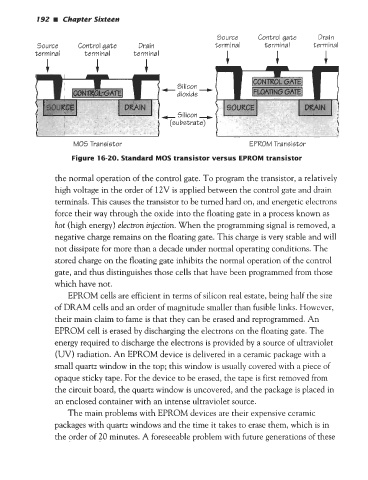
                     Figure 16-20. Standard MOS transistor versus EPROM transistor


                the normal operation of the control gate. To program the transistor, a relatively
                high voltage in the order of  12V is applied between the control gate and drain
                terminals. This causes the transistor to be turned hard on, and energetic electrons
                force their way through the oxide into the floating gate in a process known as
                hot (high energy) electron injection. When the programming signal is removed, a
                negative charge remains on the floating gate. This charge is very stable and will
                not dissipate for more than a decade under normal operating conditions. The
                stored charge on the floating gate inhibits the normal operation of the control
                gate, and thus distinguishes those cells that have been programmed from those
                which have not.
                    EPROM cells are efficient in terms of  silicon real estate, being half the size
                of DRAM cells and an order of magnitude smaller than fusible links. However,
                their main claim to fame is that they can be erased and reprogrammed. An
                EPROM cell is erased by discharging the electrons on the floating gate. The
                energy required to discharge the electrons is provided by a source of ultraviolet
                (UV) radiation. An EPROM device is delivered in a ceramic package with a
                small quartz window in the top; this window is usually covered with a piece of
                opaque sticky tape. For the device to be erased, the tape is first removed from
                the circuit board, the quartz window is uncovered, and the package is placed in
                an enclosed container with an intense ultraviolet source.
                    The main problems with EPROM devices are their expensive ceramic
                packages with quartz windows and the time it takes to erase them, which is in
                the order of 20 minutes. A foreseeable problem with future generations of these

