


Page 256 - Cam Design Handbook
P. 256
THB8  9/19/03  7:25 PM  Page 244

          244                      CAM DESIGN HANDBOOK

               5


               4


               3                    n*


             n, n*  2               –2dh/dq


               1                    –dh/dq


               0


                                    n
              –1
                0     20    40    60     80   100    120   140   160    180
                                             q
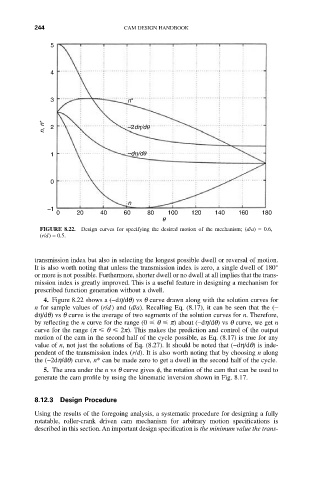
            FIGURE  8.22.  Design  curves  for  specifying  the  desired  motion  of  the  mechanism;  (d/a)  = 0.6,
            (r/d) = 0.5.


          transmission index but also in selecting the longest possible dwell or reversal of motion.
          It is also worth noting that unless the transmission index is zero, a single dwell of 180°
          or more is not possible. Furthermore, shorter dwell or no dwell at all implies that the trans-
          mission index is greatly improved. This is a useful feature in designing a mechanism for
          prescribed function generation without a dwell.
             4. Figure 8.22 shows a (-dh/dq) vs q curve drawn along with the solution curves for
          n for sample values of (r/d) and (d/a). Recalling Eq. (8.17), it can be seen that the (-
          dh/dq) vs q curve is the average of two segments of the solution curves for n. Therefore,
          by reflecting the n curve for the range (0   q   p) about (-dh/dq) vs q curve, we get n
          curve for the range (p   q   2p). This makes the prediction and control of the output
          motion of the cam in the second half of the cycle possible, as Eq. (8.17) is true for any
          value of n, not just the solutions of Eq. (8.27). It should be noted that (-dh/dq) is inde-
          pendent of the transmission index (r/d). It is also worth noting that by choosing n along
          the (-2dh/dq) curve, n* can be made zero to get a dwell in the second half of the cycle.
             5. The area under the n vs q curve gives f, the rotation of the cam that can be used to
          generate the cam profile by using the kinematic inversion shown in Fig. 8.17.


          8.12.3 Design Procedure
          Using the results of the foregoing analysis, a systematic procedure for designing a fully
          rotatable,  roller-crank  driven  cam  mechanism  for  arbitrary  motion  specifications  is
          described in this section. An important design specification is the minimum value the trans-

