


Page 202 - Catalysts for Fine Chemical Synthesis Vol 1 - Robert & Poignant
P. 202
190            hydrolysis, oxidation and reduction

               12.6  ENANTIOSELECTIVE RUTHENIUM-CATALYZED
               HYDROGENATION OF VINYLPHOSPHONIC ACIDS

               Virginie Ratovelomanana-Vidal, Jean-Pierre GenE Ã t
               Laboratoire de Synthe Áse Organique Se Âlective & Produits Naturels, Ecole Nationale Supe Âr-
               ieure de Chimie de Paris, 11, rue Pierre & Marie Curie 75231 Paris cedex 05 France, Tel: 01
               44 27 67 43 fax: 01 44 07 10 62, e-mail:genet@ext.jussieu.fr


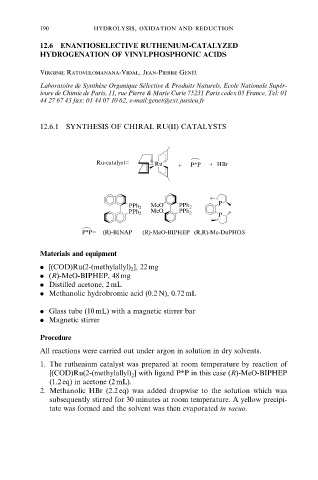
               12.6.1  SYNTHESIS OF CHIRAL RU(II) CATALYSTS


                              Ru-catalyst=    Ru     +  P*P  +  HBr


                                             MeO                P
                                       PPh 2         PPh 2
                                             MeO
                                       PPh 2         PPh 2
                                                                P
                           P*P=   (R)-BINAP  (R)-MeO-BIPHEP (R,R)-Me-DuPHOS

               Materials and equipment

               . [(COD)Ru(2-(methylallyl) ], 22 mg
                                        2
               . (R)-MeO-BIPHEP, 48 mg
               . Distilled acetone, 2 mL
               . Methanolic hydrobromic acid (0.2 N), 0.72 mL

               . Glass tube (10 mL) with a magnetic stirrer bar
               . Magnetic stirrer

               Procedure
               All reactions were carried out under argon in solution in dry solvents.
               1. The ruthenium catalyst was prepared at room temperature by reaction of
                  [(COD)Ru(2-(methylallyl) ] with ligand P*P in this case (R)-MeO-BIPHEP
                                        2
                  (1.2 eq) in acetone (2 mL).
               2. Methanolic HBr (2.2 eq) was added dropwise to the solution which was
                  subsequently stirred for 30 minutes at room temperature. A yellow precipi-
                  tate was formed and the solvent was then evaporated in vacuo.

