


Page 201 - Catalysts for Fine Chemical Synthesis Vol 1 - Robert & Poignant
P. 201
asymmetric hydrogenation of carbon±carbon double bonds         189

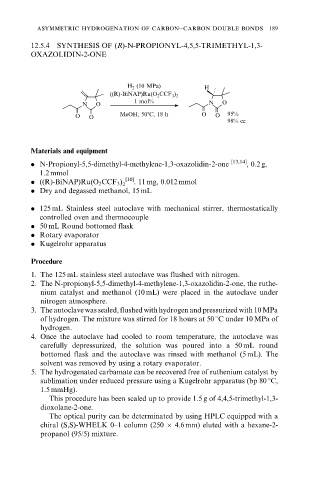
             12.5.4  SYNTHESIS OF (R)-N-PROPIONYL-4,5,5-TRIMETHYL-1,3-
             OXAZOLIDIN-2-ONE


                                       H 2  (10 MPa)        H
                                  ((R)-BiNAP)Ru(O 2 CCF 3 ) 2
                                         1 mol%              N   O
                           N  O
                         O   O       MeOH, 508C, 18 h      O   O  95%
                                                                  98% ee


             Materials and equipment
             . N-Propionyl-5,5-dimethyl-4-methylene-1,3-oxazolidin-2-one  [13,14] , 0.2 g,
               1.2 mmol
             . ((R)-BiNAP)Ru(O 2 CCF 3 ) 2 [10] . 11 mg, 0.012 mmol
             . Dry and degassed methanol, 15 mL

             . 125 mL Stainless steel autoclave with mechanical stirrer, thermostatically
               controlled oven and thermocouple
             . 50 mL Round bottomed flask
             . Rotary evaporator
             . Kugelrohr apparatus

             Procedure
             1. The 125 mL stainless steel autoclave was flushed with nitrogen.
             2. The N-propionyl-5,5-dimethyl-4-methylene-1,3-oxazolidin-2-one, the ruthe-
               nium catalyst and methanol (10 mL) were placed in the autoclave under
               nitrogen atmosphere.
             3. The autoclave was sealed, flushed with hydrogen and pressurized with 10 MPa
               of hydrogen. The mixture was stirred for 18 hours at 50 8C under 10 MPa of
               hydrogen.
             4. Once the autoclave had cooled to room temperature, the autoclave was
               carefully depressurized, the solution was poured into a 50 mL round
               bottomed flask and the autoclave was rinsed with methanol (5 mL). The
               solvent was removed by using a rotary evaporator.
             5. The hydrogenated carbamate can be recovered free of ruthenium catalyst by
               sublimation under reduced pressure using a Kugelrohr apparatus (bp 80 8C,
               1.5 mmHg).
                  This procedure has been scaled up to provide 1.5 g of 4,4,5-trimethyl-1,3-
               dioxolane-2-one.
                  The optical purity can be determinated by using HPLC equipped with a
               chiral (S,S)-WHELK 0±1 column (250   4.6 mm) eluted with a hexane-2-
               propanol (95/5) mixture.

