


Page 313 - Classification Parameter Estimation & State Estimation An Engg Approach Using MATLAB
P. 313
302                               STATE ESTIMATION IN PRACTICE

              (and possibly higher harmonics, but these will be neglected here). The
              disturbance can be modelled by two second order equations, that is:


                       2                                            3
                         cosð2 f 0  Þ  sinð2 f 0  Þ
                                                         0
                       6                                            7
                          sinð2 f 0  Þ cosð2 f 0  Þ
                                                                          v
                       6                                            7
                                                                    7vðiÞþ ~ vðiÞ
              vði þ 1Þ¼ d6
                                               cosð4 f 0  Þ
                       4                                   sinð4 f 0  Þ 5
                                  0
                                                sinð4 f 0  Þ cosð4 f 0  Þ
                                                                       ð8:58Þ
              The factor d is selected close to one, modelling the fact that the
              magnitudes of each component vary in time only slowly.
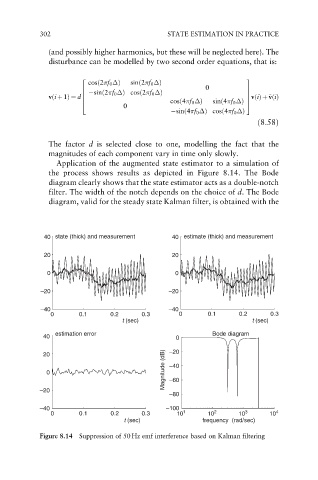
                Application of the augmented state estimator to a simulation of
              the process shows results as depicted in Figure 8.14. The Bode
              diagram clearly shows that the state estimator acts as a double-notch
              filter. The width of the notch depends on the choice of d.The Bode
              diagram, valid for the steady state Kalman filter, is obtained with the


             40 state (thick) and measurement   40 estimate (thick) and measurement

             20                                 20

              0                                 0

            –20                                –20

            –40                                –40
               0      0.1      0.2     0.3       0       0.1      0.2     0.3
                                  t (sec)                            t (sec)
                estimation error                          Bode diagram
             40                                  0
                                             Magnitude (dB)  –40
             20                                –20
              0                                –60


            –20
                                               –80
            –40                               –100
               0      0.1      0.2     0.3       10 1    10 2    10 3     10 4
                                   t (sec)              frequency  (rad/sec)

            Figure 8.14  Suppression of 50 Hz emf interference based on Kalman filtering

